Case study
Honour, from Pawn to Postscript
A two-century study of one word, in 5,000 sentences.
Finding. Honour is one of the most frequent abstract nouns in both corpora. In Shakespeare its closest verbal neighbours are pawn, mine, lord, love, Brutus: the vocabulary of staking, addressing, and defending. In the Founders its closest neighbours are sir, respect, esteem, letter, excellency, sentiments: the vocabulary of letter-closing protocol. The word travelled across two centuries; the concept did not—though the statistical signal, the project is careful to say, is faint.
A note before you read. This case study is now part of the project’s Stylistic notes section, which collects findings about prose register rather than direct citation. The project isn’t claiming Shakespeare owned the word honour: both corpora use it constantly. The finding is that the collocates (the words that habitually appear next to honour) diverge. And the divergence may reflect genre (drama vs epistolary prose) as much as concept. The full caveat is in the Notes overview.
On the Honour Test explorer page of this site, the reader can pick from fourteen common abstract nouns ( honour, love, power, liberty, friend, virtue, death) and see the top twenty words that most distinctively keep each one company, side by side in the two corpora. The interactive view shows what the frequency table records. This case study takes one of those fourteen nouns, the most striking of them, and walks through what the contrast means.
The word is honour. The Founders use it about as often as Shakespeare does, normalized per million words. Both corpora are saturated with the word. A reader inspecting either corpus alone would have no clue that anything has shifted between Shakespeare and the Founders, because the word itself is everywhere. The differential collocate analysis is what surfaces the shift. It asks not how often the word appears in each corpus (that question is uninteresting) but what kinds of words sit next to it in each.
Shakespeare’s honour: something to stake
The top distinctive collocates of honour in Shakespeare are mine, lord, love, pawn, come, Brutus, like. Every one of those words names a different action that honour can be involved in. The whole vocabulary treats the noun as something that has shape, weight, ownership, an exchange-value:
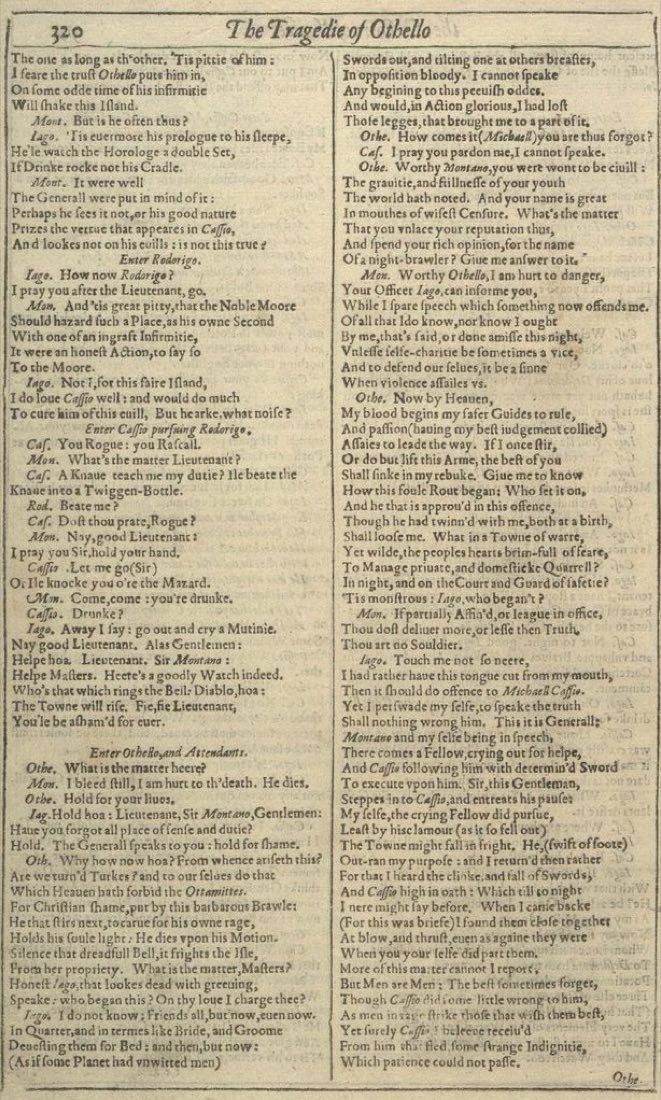
Aufidius says he pawned his honour for another man’s truth, as one might pawn a watch as security on a loan. The metaphor is mercantile: honour can be put up against a debt, redeemed, lost, defaulted on. The Cymbeline gambler wagers honour as he wagers gold. Othello’s tragedy is about losing honour the way one loses property. Mine honour: the possessive is doing real grammatical work. The noun is something that belongs to the speaker, that the speaker has standing to stake.
Celia swears by mine honour, then conditions the oath: if she breaks it, let her turn monster. Honour is what you swear by, the thing whose loss would make you no longer yourself. This usage runs through the comedies and the history plays as well as the tragedies. Antony asks pardon so far as befits mine honour to stoop. Brutus commits suicide because his honour is constrained. Hotspur’s entire personality is calibrated to a notion of honour as the thing for which he will die.
The other top collocate is the proper name Brutus, because Mark Antony’s funeral oration in Julius Caesar turns the word honourable into a thirty-line ironic refrain. “For Brutus is an honourable man,” over and over, until the word has been emptied of moral content and refilled with sarcasm. This is the play in which Shakespeare most pointedly questions what honour means. The interrogation is itself proof that the concept has substantive content available to interrogate.
The Founders’ honour: something to sign with
Now turn to the Founders’ side. The top distinctive collocates of honour in their 23.7 million words are a completely different set: sir, respect, great, esteem, letter, excellency, sentiments, inclose. Almost every one of those words tells you something about the immediate textual environment honour sits in. It is the closing of a letter:
This is not Franklin being unusual. Every Founder ends every formal letter this way. The construction I have the honour to be, with great esteem, sir, your most humble servant is so completely the standard eighteenth-century epistolary protocol that, run through a corpus, it dominates every other use of the word combined. Sir is the top collocate because honour in the Founders is the word that introduces the addressee. Esteem and respect are the next collocates because they are the formula’s near companions. Excellency is a collocate because that’s how you addressed a foreign minister or a general (Washington was “Your Excellency” for most of the Revolution). Inclose is a collocate because the same paragraph in which you have the honour to be your correspondent’s humble servant is the paragraph in which you inclose the documents the letter is forwarding.
The Founders’ honour, in other words, is the verbal residue of formal correspondence. Eighteenth-century gentlemen wrote to each other constantly (thousands of letters per career, hundreds of thousands across the six Founders in the corpus) and the word that closed each of those letters is the word the differential collocate analysis surfaces as their most-distinctive use of the noun.
Why the contrast matters
Two things follow from the contrast that don’t follow from a frequency table.
The first is that honour at the level of frequency is a false friend. Both corpora use the word constantly; the word itself looks like proof of continuity. The collocates show the continuity at the word level is doing different work in each. The same noun appears as a substantive in Shakespeare (an object of action: you can pawn it, swear by it, lose it, die for it) and as a discourse marker in the Founders (a protocol register: you sign with it). How much of the difference is genuine conceptual divergence vs how much is the genre contrast (drama vs epistolary prose) is hard to separate cleanly from the data; the project records the contrast as the contrast and lets the reader judge.
The second is that this is not just a feature of honour. The Honour Test explorer applies the same analysis to power, love, liberty, virtue, friend, law, government, and seven others. The pattern repeats for almost all of them. Power in Shakespeare is something one has over another person; in the Founders it is something one vests in a legislative body. Love in Shakespeare is the engine of plays; in the Founders it is the way one closes letters to family. Friend in Shakespeare is a complex relational role; in the Founders it is the noun that ends with my dear and starts with your humble servant.
The case study’s working hypothesis (the live data is in the Honour Test explorer) is more cautious than the project’s earlier framing suggested. The contrast shows a real difference between the company honour keeps in Shakespeare’s drama and in the Founders’ epistolary prose. That genre contrast (drama vs letter-writing) is itself doing a lot of the work in the result, and the project does not want to overclaim that the Founders rebuilt Shakespeare’s concept from scratch. What it can say is that the same noun is doing different jobs in the two corpora.
Pawn it, swear by it, die for it: these are the Shakespearean uses, and they are now archaic uses. To have the honour to be your humble servant: that is the Founders’ use, and it is (vestigially, in formal letters that still get written today) the use that survives. The American eighteenth century is when the inheritance happened.
Try the same contrast on the other thirteen abstract nouns in the Honour Test explorer, where the full collocate tables for all fourteen nouns live.