Case study
There Is a Tide
John Adams quotes Brutus’s ‘tide in the affairs of men’ five times across thirty-eight years, in five different moods.
Finding. Of the sixty-one verbatim Shakespeare quotations Adams produces, this one line (from Brutus to Cassius in Julius Caesar 4.3) recurs more than any other. It appears in his Revolutionary correspondence of 1776, in his diplomatic letters of 1781, in his published memoir of 1809, in a private letter of 1812, and in a philosophical reflection to Richard Rush in 1814. The same words mean something different each time.
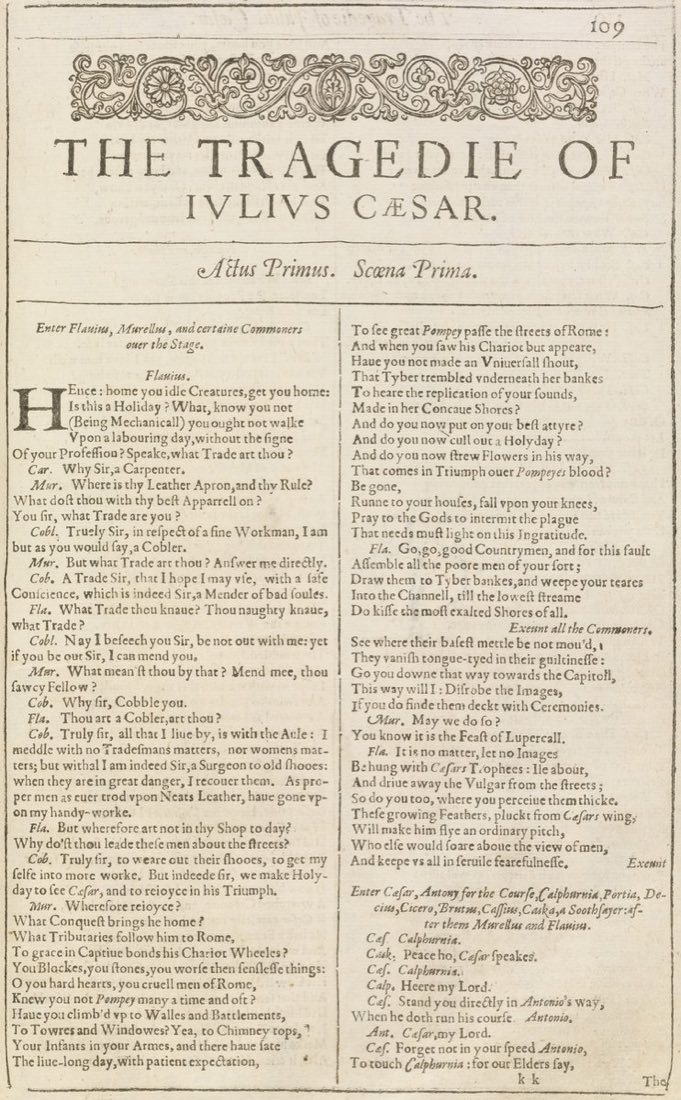
The line comes from Act 4 Scene 3 of Julius Caesar, in Brutus’s argument with Cassius the night before the battle of Philippi. Brutus wants to march on Antony’s army immediately; Cassius wants to wait. Brutus prevails. The argument turns on a metaphor:
There is a tide in the affairs of men,
Which, taken at the flood, leads on to fortune;
Omitted, all the voyage of their life
Is bound in shallows and in miseries.
On such a full sea are we now afloat;
And we must take the current when it serves,
Or lose our ventures.
It is Brutus’s most quoted speech outside “Et tu, Brute?” The metaphor is unambiguous: take the moment when the tide is high, or be left in the shallows. In Shakespeare’s play the speech precedes a decision that proves catastrophic; Brutus marches, Brutus loses, Brutus falls on his sword in the next act. Adams omits that context.
1776: the Revolutionary spring
The first use we have appears in a letter to William Heath, a senior Continental Army officer, on 15 April 1776. The Continental Congress has been arguing for months over whether the colonies should formally declare independence. Adams writes:
Adams uses the line as Brutus uses it: an exhortation to act immediately. The independence declaration was adopted eleven weeks later. Adams was forty years old.
1781: the peace negotiations
Five years later he is in Amsterdam, trying to negotiate Dutch recognition and a loan. He writes to C. W. F. Dumas, the polyglot publicist at The Hague who served as a back-channel for the American delegation, on the politics of waiting too long:
Two things to notice. First, Adams now puts the line in quotation marks; he is consciously citing. Second, he writes at the Ebb, where Shakespeare wrote at the flood. The error makes the metaphor incoherent (one takes a tide at the flood, not the ebb, to ride it to fortune), but it captures the diplomatic moment exactly: the Continental cause is ebbing, and Adams is arguing that the Dutch will not move unless the Americans move first. The Shakespearean line has been re-tuned to the immediate political instrument.
1809: Adams quoting Adams
Twenty-eight years later, in retirement, Adams is publishing a long autobiographical memoir in the Boston Patriot, defending his diplomatic record against Federalist attacks. He reproduces the same line from the same 1781 letter, almost verbatim:
Adams is quoting himself as much as he is quoting Shakespeare. The 1781 misquote (ebb for flood) is reproduced exactly, twenty-eight years on. The Shakespearean line has become part of his own self-citation.
1812: personal melancholy
In a private letter to his son-in-law William Stephens Smith on 15 October 1812, Adams is in a darker register. His daughter Nabby (Smith’s wife) is fighting the breast cancer that will kill her the following August. The country is at war with Britain again. He writes:
The 1781/1809 misquote is gone; he writes flood, as Shakespeare did. He also extends the quotation, picking up the next lines (Omitted, all the Voyage of Life) which neither the 1776 nor 1781 use included. The line is no longer political instrument; it is personal lament. The metaphor that began as Brutus’s case for marching against Antony is now Adams’s case against his own life.
1814: the line as historical commonplace
Two years later, writing to Richard Rush (the son of Adams’s old friend Benjamin Rush) he uses the line once more, this time at a remove:
Adams now calls it “a trite observation of Historians.” The line has slipped from quotation to proverb: from a Shakespearean speech to a piece of received political wisdom that Adams, almost eighty, attributes vaguely to “Historians.” It is the same words. It is no longer the same citation.
Thirty-eight years on one line
1776
the founding moment
William Heath
1781
diplomatic post-war
C. W. F. Dumas
1809
memoir for the Boston Patriot
(quoting himself, 28 years later)
1812
personal melancholy
William Stephens Smith
1814
philosophical reflection
Richard Rush
The five uses sit at five distinct phases of Adams’s public life. In 1776 the line urges the founding act. In 1781 it explains Dutch reluctance. In 1809 it appears in a memoir as a diplomatic talking-point Adams is proud of. In 1812 it is a private grief. In 1814 it is a commonplace. The words do not change. Adams does.
There’s a useful lesson buried in this. A computer that scans the corpus for verbatim Shakespeare matches will find each of Adams’s five uses individually and stop. It will list five hits and move on. What it can’t see is the second-order pattern: that the same line, retained verbatim across nearly four decades, is being applied to a different situation each time. The data can locate the trace. The historian still has to read it.
This is one of the cleaner illustrations of what we call, in the companion essay, the citational mode of Shakespearean influence: Adams keeps the words intact, signals them as quotation when he chooses, and applies them to the situation at hand. The same line in Franklin’s writing would have been absorbed into the texture of his prose: used once or never, and indistinguishable from his own voice. Adams’s tide is the legible half of Shakespearean inheritance. The illegible half is described in the next case study.
See also Two Modes of Shakespearean Influence for the broader argument, and the explorer to browse the full catalogue of Adams’s sixty-one verbatim Shakespeare quotations.