Essay · The substantive findings
Chapter 4 of 9
Two Modes of Shakespearean Influence
Adams citational, Franklin absorbed, and why the corpus needs both methods to see them.
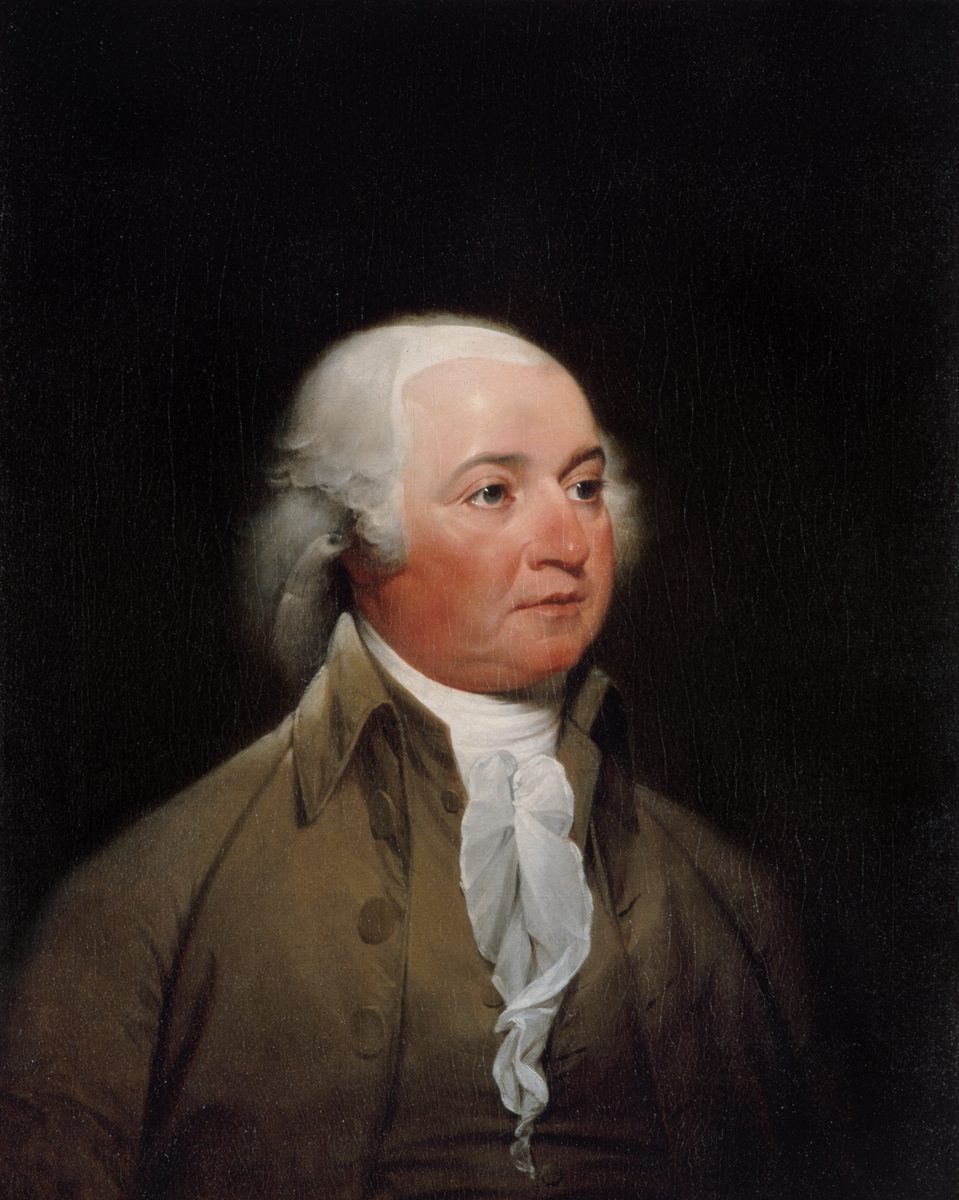
John Adams (Trumbull, c. 1792)
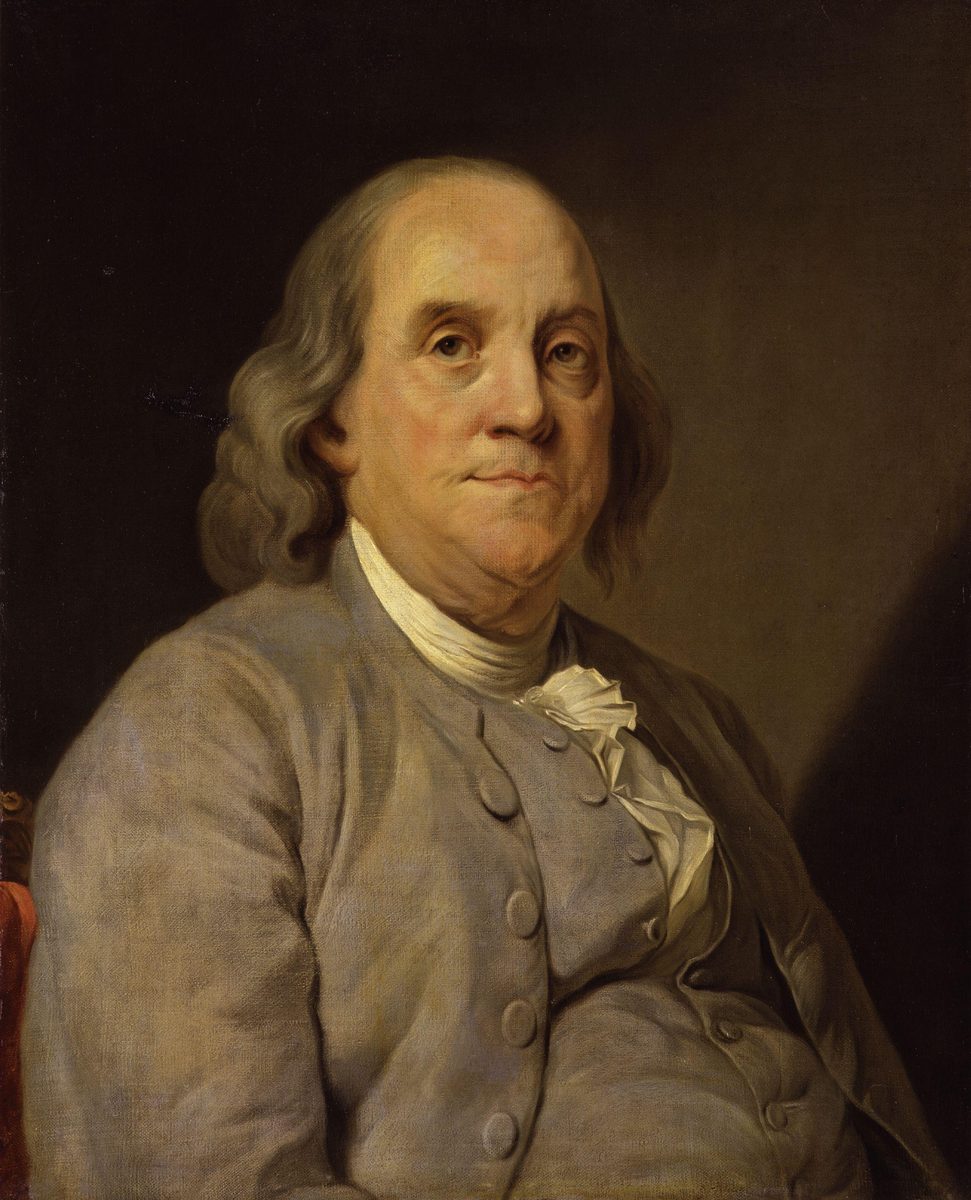
Benjamin Franklin (Duplessis, c. 1785)
The natural question to ask of a project like this one is who’s most Shakespearean?, and to expect a single name. The data answers half the question. John Adams leads the project’s composite ranking, and Benjamin Franklin sits a step behind. Together they take the top two positions on seven of the project’s eleven measures. The interesting finding is that they got there in completely different ways.
Adams quotes Shakespeare. He names him. He copies passages out into his diary at twenty-three and goes on returning to favourite lines for the next sixty years. Franklin almost never names Shakespeare and almost never quotes him. But every time Franklin reaches for a verb form, or a contraction, or a way to phrase a sentence, the form he reaches for is the older form, the one Shakespeare’s century used, even when, by 1780, almost no other writer was using it. One Founder inherits a writer. The other inherits a way of writing.
Adams, the conscious Shakespearean
John Adams refers to Shakespeare by name more often than the other five Founders combined. He does so more than forty times across his life: in his diaries from 1757 onward, in literary-critical reflections of 1772, in correspondence about contemporaries he wants to characterise, in his retirement reading of 1803, and in his late-life letters of 1809 and beyond. He uses fifteen of the twenty-four phrases popularly attributed to Shakespeare in compilations like Crystal’s Think on My Words, with 139 hits total, more than any other Founder by a wide margin.
In the closing months of 1758 (the entries run from October to December, probably written over several sittings), the twenty-three-year-old Adams, recently admitted to the bar in Massachusetts, fills several pages of his diary with an extended literary-critical reflection on Shakespeare. Among other things he transcribes from memory the “Tomorrow, and tomorrow, and tomorrow” soliloquy from Macbeth Act 5 Scene 5:
The diary continues with Macbeth’s account of Duncan’s horses turning wild after the murder, with the night portents preceding Banquo’s death, and with brief glosses on character; a letter to his friend Richard Cranch that same year carries Othello’s farewell speech from Act 3 Scene 3 (“Now forever farewell the tranquil mind” into “Pride, pomp, and circumstance of glorious war”). The 1758 cluster, sixteen Macbeth quotations in the diary and six Othello quotations in the letter, produces twenty-two of Adams’s sixty-one verbatim Shakespeare quotations.
The pattern continues across his life. He returns to one line from Julius Caesar, Brutus’s “tide in the affairs of men”, in correspondence in 1776, 1781, 1809, 1812, and 1814, applied variously to the founding moment, the diplomatic post-war, the early Republic, and his own declining years. He uses Othello’s “Pride, pomp, and circumstance of glorious war” in letters of 1775, 1777, 1780, and 1809. Eight months before his death in 1822 he applies Antony’s “Cry havoc, and let slip the dogs of war” to a passage of Franklin’s political theology that he is criticising.
Adams treats Shakespeare as an applied literature. Lear’s madness describes a drunk tavern-keeper in Braintree (1758). Lady Macbeth’s “I have given suck” gets ranked against Herod’s massacre of the innocents to measure England’s conduct toward America (1782). The Tide speech describes the founding moment, the diplomatic post-war, and his own decline. He uses Shakespeare the way a lawyer uses a casebook: as a vocabulary for analysing political and emotional situations he encounters in life. There is no quotation in this corpus that is decorative.
Franklin, the absorbed Shakespearean
Benjamin Franklin produces almost none of the surface evidence Adams produces. He names Shakespeare twice in the entire corpus: once in 1775, in a playful epistolary postscript addressed to “Mr. Shakespeare”, and once in 1783, in a Paris letter where he quotes Othello’s “Trifles light as air” without attribution as part of his own voice. Of the twenty-four phrases popularly attributed to Shakespeare, he uses only four, with eleven hits, fewer than every Founder but Madison. He produces zero verbatim seven-word Shakespeare quotations under our automated detection pipeline.
If we stopped counting at this point, Franklin would look like the least Shakespearean Founder. He isn’t. He sits second on the project’s top-line ranking, a step behind Adams.
Franklin’s Shakespearean side shows up not in what he writes but in how he writes it. He uses thou, thee, thy, thine (the second-person pronouns that had largely died out of American English by 1750) hundreds of times more often than Washington and roughly fifteen times more often than Hamilton. He uses the old verb forms hath, doth, art, hast at a higher rate than any other Founder. He uses old-style contractions like ‘tis, ‘twas, ‘twere two and a half times as often as the next-highest writer in the corpus.
The single most striking piece of evidence is the contraction ‘tis. Shakespeare uses it constantly. The form saturates his text. In ordinary 18th-century English the form was vanishing. Franklin uses it at two and a half times the rate of any other Founder, beginning in 1722 in essays he was publishing anonymously, at the age of sixteen, in his half-brother’s newspaper. ‘Tis never leaves his prose; he was still using hath in formal diplomatic correspondence from Paris in 1778, fifty-six years after the first uses.
A teenage printer’s apprentice in Boston in 1722 was already writing in a register a half-century out of date. The Founder with the least formal education writes the most Shakespearean prose in the corpus. The natural reading is that Franklin learned to write English by reading writers like Shakespeare and then never re-learned. The absorption stuck because it happened in the years his writing habits were being formed; it was beneath the level of conscious citation by the time anyone would have noticed.
Both modes, side by side
The chart below combines ten different ways of measuring how much of Shakespeare survives in each Founder’s writing. Each Founder gets a percentage on each measure; the bar shows the average. Two big takeaways:
First, Adams leads the composite, with Franklin a step behind; together they take the top two spots on seven of the project’s eleven measures. Second, Madison and Hamilton are the project’s two least Shakespearean writers, sitting much further back than Franklin sits from Adams. Under the project’s strict Shakespeare-only standard (which sets aside Roman names like Brutus and Caesar that reach the Founders through Plutarch as much as through Shakespeare) Madison sits alone at the bottom of the composite at 0.11 (a source-level audit dropped two false positives that had previously tied him with Hamilton, and the v3 corpus cleaning pushed him lower still), and Hamilton ranks one step above him at 0.25.
Within the top two, the comparison is more interesting than the scores. Adams leads on measures of what words a Founder used: the breadth of distinctively Shakespearean vocabulary in his writing, the named-phrase count, the diversity of collocations he picked up. Franklin leads on measures of how often: the rate per million words, the proximity of his pronoun-use to Shakespeare’s, the density of his old-fashioned forms. Adams collected. Franklin absorbed.
Why both modes are real
It would be easy to dismiss one of these modes as the “real” kind of influence and the other as not really influence at all. That would be a mistake. Each mode is invisible to the method that catches the other.
If you build a catalogue of every passage where a Founder quotes Shakespeare verbatim (the kind of catalogue you’d expect to find in a literary monograph) you’ll find Adams sixty-one times and the other five Founders zero times. The catalogue will tell you Adams is the Shakespearean Founder. It will not see Franklin at all.
If you instead measure the per-million rate of old-fashioned English forms across each Founder’s entire corpus (the kind of statistical scan that doesn’t care about specific passages) you’ll find Franklin nearly twice as Shakespearean as the next-highest Founder. That scan will see Franklin clearly. It will not see Adams’s deliberate quotations as anything special.
Any single overall score averages the two together and loses the shape of what each Founder did. That’s why the finding only became visible once the project ran a wide set of independent measures and started to notice that they disagreed in a particular shape: Adams kept winning when the measure was about specific content, Franklin kept winning when the measure was about overall texture.
There’s one more thing worth noticing. Adams’s Shakespearean engagement peaks in his early diaries and slowly fades as his prose hardens into the administrative register of the Revolution and the presidency. Franklin’s Shakespearean register has no peak at all. It’s the baseline of his prose across six decades of writing: present in 1722, still present in 1778. One Founder went looking for Shakespeare and brought him home in pieces. The other writes as if the English of Shakespeare’s century is the English he learned and never re-learned. Both are real kinds of influence. Neither one is more “influence” than the other.
The citational mode is consistent across all three of the project’s evidence tiers. The strict catalogue is heavily Adams. The middle tier of candidate echoes is heavily Adams. The thematic-allusions scan, which looks for Founders invoking Shakespearean characters as types, finds nineteen cases across the whole corpus (after deduplicating within-document character repeats); fourteen are Adams. Whichever threshold the evidence is filtered at, the same Founder dominates. That consistency is what makes “citational” the right word for what he’s doing.
▸How we measured this, for the methodologically curiousHow we measured this
The composite ranking averages ten base measures of Shakespearean inheritance after putting them on the same scale (each Founder is ranked 1 to 6 on each measure; the matrix adds an overall row, for eleven rows in all). Seven of the ten are stylistic or statistical: pronoun-distribution similarity, archaic-form survival, metaphor patterns, statistical-style overlap under Configural Frequency Analysis, use of Shakespeare-coined phrases, Shakespearean vocabulary, and Shakespearean context patterns. The remaining three count passage-level evidence per million words: verified catalogue references, thematic character invocations, and candidate-echo density.
All statistical tests follow Stefanowitsch (2020) Corpus Linguistics: A Guide to the Methodology and use the G log-likelihood test with Bonferroni correction within each comparison. The Configural Frequency Analysis behind the “shared stylistic types” claim is described in the full paper.
For the contrasting view of what happens to the same vocabulary item when it travels from Shakespeare to the Founders, see the Honour Test explorer.