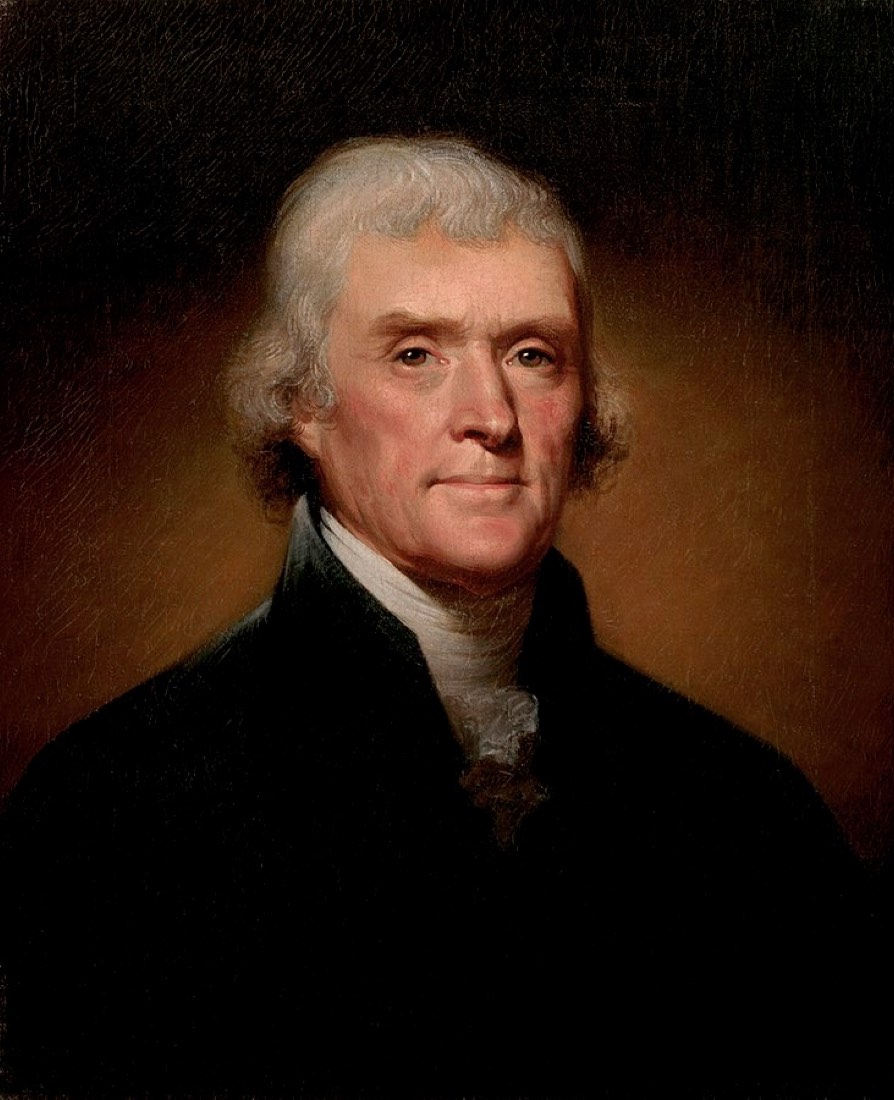
Founder profile
Thomas Jefferson
1743–1826
The educated reader's Shakespeare. Twenty-six by-name references, zero direct quotations, and four Roman character invocations (Brutus, Caesar) that are ambiguous between Shakespeare and Plutarch and not scored under the strict standard.
26
Catalogue references(0 direct + 26 by-name)
130
Candidate echoes (MED+)(9,167 including LOW)
0
Shakespeare-only invocations(4 Roman-ambiguous, not scored)
44%
Archaic forms surviving
In summary
Jefferson is the educated eighteenth-century reader's Shakespeare. The catalogue records 26 by-name references and zero direct verbatim quotations in the strict tier; the candidate-echoes tier surfaces 9,167 short matches with 130 in the MEDIUM-or-HIGH band. His thematic-character invocations (Brutus, Caesar) are Roman-ambiguous and fall outside the strict Shakespeare-only standard — Plutarch and the classical curriculum both reach those names independently. So under methodology v3 he records zero scored Shakespeare-only invocations. His engagement is general rather than play-specific: an archaic-form density second only to Franklin's, the gentleman's letter-closing protocol of borrowed phrasing, and an interest in Shakespeare's language as a window into the historical development of English (he made the case explicitly in his 1825 dialects essay). The Honour Test material in the Stylistic Notes section uses his pattern of usage to illustrate how period-standard Shakespeare lived in 18th-century educated prose.
Metaphor signature
His metaphor fingerprint
Per-million rates across eight conceptual-metaphor families. Red is his profile; blue dashed silhouette is Shakespeare’s for comparison.
Thomas Jefferson
Eleven measures
How he ranks across the project’s eleven measures
Lower number = more Shakespearean. Compare with other Founders →
Plays referenced
Which Shakespeare plays appear in his catalogue
- Comedy of Errors1 ref
- King Lear1 ref
- The Merchant of Venice1 ref
Case studies
No focused case study yet
Jefferson appears in the catalogue 26 times in by-name references but no HIGH/MEDIUM direct quotations. The collocational analysis of shared abstract nouns (which includes his prose alongside the others) is in the Stylistic notes section.