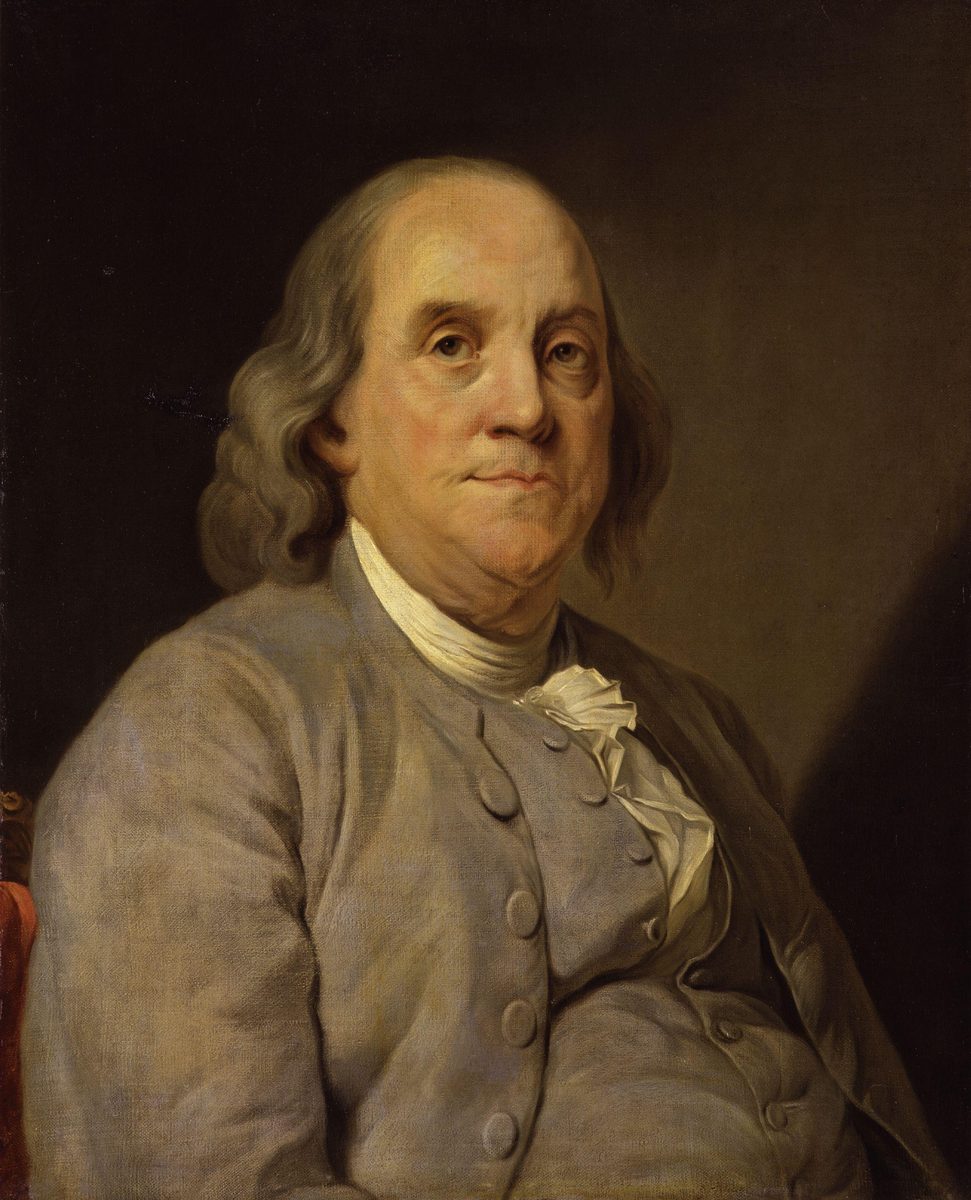
Founder profile
Benjamin Franklin
1706–1790
Older-English register overlap, not direct Shakespeare absorption. Almost no quotation, but the highest archaic-form density of any Founder; the late-Stuart prose he learned in 1722 sits closer to Shakespeare's than any other Founder's.
2
Catalogue references(0 direct + 2 by-name)
81
Candidate echoes (MED+)(3,664 including LOW)
0
Shakespeare-only invocations
69%
Archaic forms surviving
In summary
Franklin is the closest of the six to Shakespeare's prose on every statistical measure that doesn't require him to say so. His writing sits closer to Shakespeare's than any other Founder's on archaic-form survival, vocabulary, and statistical style, and his candidate-echoes density (3,664 total, 81 in the MEDIUM-or-HIGH band, second per million only to Adams) is the highest of the five non-Adams Founders. The cause, though, is not direct Shakespeare absorption: Franklin's prose carries the older-English / late-Stuart register he learned in his half-brother's print shop in 1722, the same register that Bunyan, Addison, and the King James Bible all share with Shakespeare. The 'Tis Franklin's Signature case study traces the contraction back to the Silence Dogood essays at age sixteen and reads it as period-style overlap, not Shakespearean direct citation. His strict catalogue is nearly empty: zero direct quotations and two by-name references in 1.6 million words.
Metaphor signature
His metaphor fingerprint
Per-million rates across eight conceptual-metaphor families. Red is his profile; blue dashed silhouette is Shakespeare’s for comparison.
Benjamin Franklin
Eleven measures
How he ranks across the project’s eleven measures
Lower number = more Shakespearean. Compare with other Founders →
Plays referenced
Which Shakespeare plays appear in his catalogue
None at the catalogue’s HIGH or MEDIUM confidence threshold. Benjamin Franklin’s engagement with Shakespeare, if any, lives below the catalogue: in vocabulary, archaic-form survival, and metaphor profile rather than in named or quoted reference.