Case study
‘Tis: Franklin’s Signature Contraction
The absorbed-mode counterpart to Adams’s citational Shakespeare. A printer’s apprentice learns to write English in 1722 and never stops writing the English of Shakespeare’s century—long after it goes out of style everywhere else.
Finding. Franklin uses the contraction ‘tis (and its archaic siblings ‘twas, ‘twere) at roughly two and a half times the rate of any other Founder, and at more than ten times the rate of Adams and Washington. The first uses appear in Silence Dogood in May 1722, when Franklin was sixteen. They never leave his prose. Hath survives into his 1778 diplomatic correspondence from Paris, fifty-six years later. This is the second mode of Shakespearean influence in the project’s two-mode argument: invisible to any catalogue of quotations, recoverable only from rate-normalised aggregate statistics on the whole corpus.
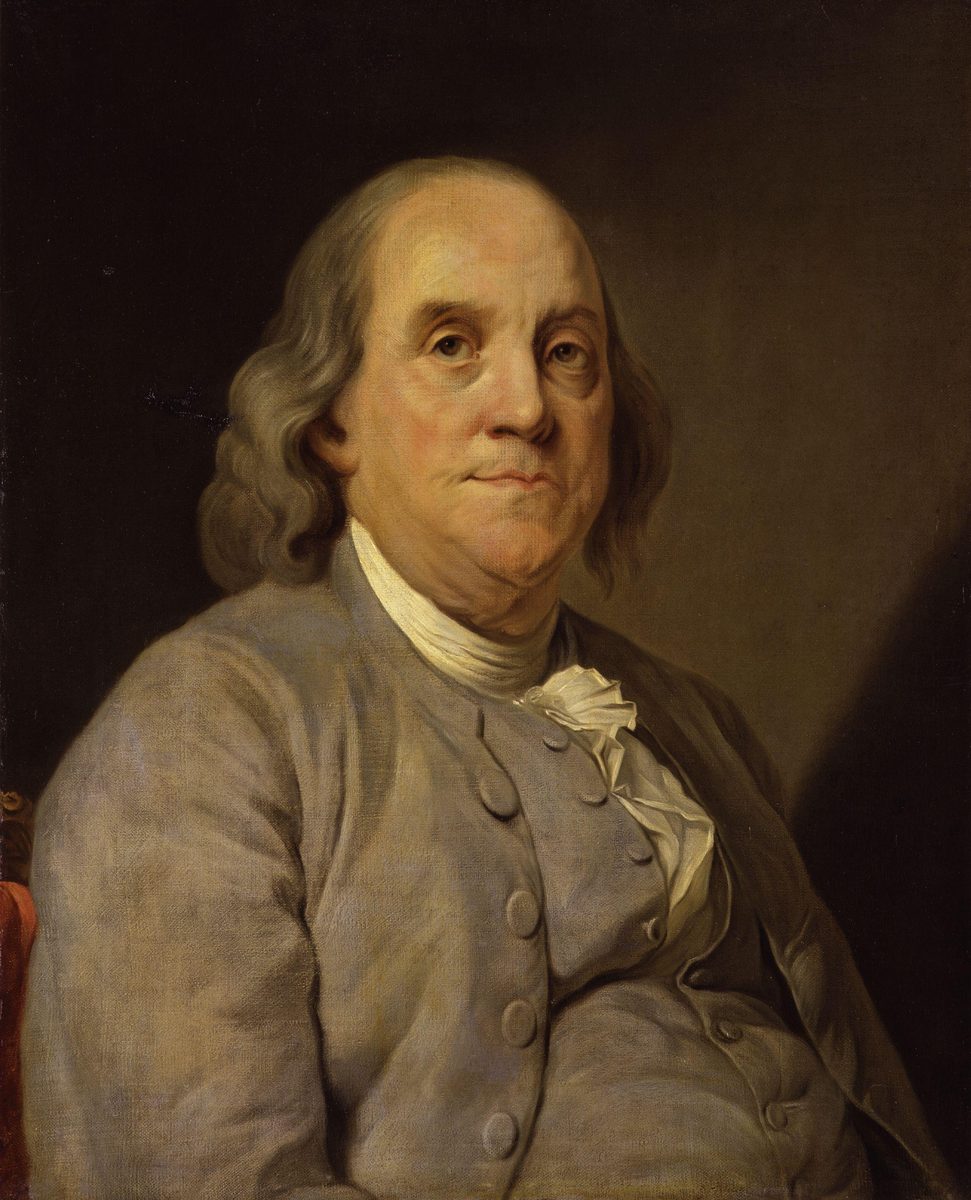
A note before you read. This case study is now part of the project’s Stylistic notes section, which collects findings about prose register rather than direct citation. The finding here is real, but easily over-claimed: Franklin’s archaic-form rate probably reflects late-Stuart English in general (and his early-eighteenth-century reading) more than Shakespeare in particular. The full caveat is in the Notes overview.
The other case studies in this project are about specific passages. There is a tide in the affairs of men. A band of brothers. Lines that travel across decades of one Founder’s correspondence, acquiring different uses as the life around them changes. The catalogue can find them; a human reading can interpret them.
This case study is about something the catalogue cannot find. Franklin’s Shakespearean inheritance does not show up as a passage, or a phrase, or a named reference. He almost never mentions Shakespeare. He almost never quotes Shakespeare. Of twenty-four phrases popularly attributed to Shakespeare, he uses only four, fewer than any Founder but Madison. He produces zero verbatim seven-word Shakespeare matches in our entire passage-level catalogue.
And yet, by every measure of register, his prose is the most Shakespearean in the corpus.
The number, first
Shakespeare’s rate of ‘tis (1,608 per million words) sits four times beyond the rightmost Founder bar. The contraction saturates his text. In general eighteenth-century English the form was vanishing; by 1750 the elision it is → ‘tis was an archaism, a deliberate flourish, a vestige of Stuart-era prose. Franklin uses it at a rate intermediate between the most-archaic Founder and Shakespeare himself.
1722: a printer’s apprentice
Franklin’s half-brother James founded the New England Courant in 1721, one of the first fiercely independent newspapers in the colonies. Sixteen-year-old Benjamin was an apprentice in the print shop, sleeping on a typesetting bench. Forbidden from publishing under his own name, he slipped an anonymous letter under the print-shop door on the night of 2 April 1722, signed “Silence Dogood”: an imagined widow whose voice he had taught himself by copying out the Spectator essays of Addison and Steele.
He published fourteen Silence Dogood essays in eight months. The first time he reaches for the archaic contraction is in No. 5, on 28 May 1722, in a passage on women’s education:
It would be unsurprising in a London essay of 1700. In a Boston newspaper of 1722, written by a sixteen-year-old who has been teaching himself prose by transcription, it is a stylistic tell: he is reading something older than the periodicals around him. A month later, in No. 7 (25 June 1722), the same construction appears in a column on poetic style:
1725: the free-will tract
Three years later, in London, the nineteen-year-old Franklin prints a philosophical pamphlet of his own composition, A Dissertation on Liberty and Necessity, Pleasure and Pain. He would later try to suppress every copy. The pamphlet is sixteen pages of late-Stuart prose-style reasoning. Two of the most striking uses of hath (the archaic third-person singular Shakespeare uses fifty times in Macbeth alone) appear in the same paragraph:
Adams uses hath at 68 per million words across his career, one of the highest rates among the Founders. Franklin uses it at 153 per million, the highest. The first documented uses arrive at nineteen, in a London philosophical pamphlet whose argumentative structure is recognisably late-Stuart.
1729: the form holds
Four years later, back in Philadelphia, Franklin and Hugh Meredith have taken over the Pennsylvania Gazette. To promote it Franklin invents another satirical persona: “Martha Careful” and “Caelia Shortface,” composite voices of a women’s gossip circle. He useshath at the natural moments:
This is not the prose of a sixteen-year-old apprentice imitating an older register. This is twenty-three-year-old Franklin writing in his own established voice, in his own newspaper, in a piece intended to be a comic burlesque of women’s gossip. Hath is doing nothing fancy here; it is simply the form he reaches for, in a context where every other writer of 1729 American English would have written has.
1778: the diplomat at Passy
Fifty-six years after the first Silence Dogood essays, Franklin is seventy-two and living in Passy, just outside Paris, as the American commissioner to the Court of Versailles. His correspondence from this period is the most professionally consequential writing of his career. The archaic forms continue:
He is writing on behalf of the United States to the highest courts of Europe. He is seventy-two. The man has been writing for fifty-six years and his prose is still calling kings of the two Sicilies things like “hath ordered.” The form is not an affectation; it is the English he learned, and he never re-learned.
What this case study shows about method
The Adams tide case study and the Washington Band-of-Brothers case study both rest on the same kind of evidence: specific passages, dated, in identifiable letters, addressed to known recipients. The catalogue pipeline finds them; a human reading gives them weight. This case study rests on something different. There is no passage to point to. There is no quotation Franklin is making. There is no Shakespearean line in his text that he could have intended.
What there is, instead, is a register: a steady background hum of old-fashioned English running through everything he wrote. ‘Tis appears 612 times. Hath shows up at a rate of about one every 6,500 words. Thou, thee, thy, thine (pronouns that had largely died out of American English by 1750) show up hundreds of times more often in Franklin than in Washington. Doth, art, hast, mayst, dost: all elevated. The texture of Franklin’s prose is late-Stuart English at densities no other Founder gets close to.
That texture is the thing a passage-by-passage search can’t find. To register as a verbatim Shakespeare quote, a Founder would have to use five or more Shakespeare words in a row. Franklin’s Shakespearean side is spread across every sentence one contraction or one verb-form at a time, never in long runs. Catching it requires a different kind of analysis: counting old forms across the whole corpus, comparing pronoun distributions, looking at the texture rather than the surface.
The Founder with the least formal education writes the most archaic-form-saturated prose in the corpus. Franklin never attended a university. He was apprenticed at twelve. The other five Founders had Harvard, Princeton, or William and Mary educations. Whatever older English entered Franklin’s prose entered it through reading: unmediated by classroom instruction, unmarked by literary self-consciousness, and absorbed during the years when his prose habits were being formed in his half-brother’s print shop in 1721 and 1722. Shakespeare is one source for that older English; Bunyan, Addison, the King James Bible, and the late-Stuart pamphlet tradition are others.
This is the absorbed mode. The Adams case studies illustrate the citational mode: deliberate, named, retrieved. Franklin illustrates the absorbed mode: continuous, unsignalled, invisible to any reader who isn’t counting. Both modes are real. Neither is more “influence” than the other. The argument of the project (that both modes are needed to see the full shape of Shakespeare’s inheritance in the Founders) is, in the most literal sense, the argument these case studies make jointly.
See also There Is a Tide and Band of Brothers at Valley Forge: the citational counterparts. The broader argument is in Two Modes of Shakespearean Influence.