Case study
Band of Brothers at Valley Forge
On 6 April 1778, with his army dissolving from cold and disease, Washington paraphrases the St. Crispin’s Day speech. The phrase recurs four more times across the next twenty years.
Finding. In our corpus, George Washington uses the phrase band of brothers five times across two decades, beginning at Valley Forge in 1778, where Continental Army losses to disease, cold, and hunger would run to roughly one in six over the encampment. The line travels with him through the Farewell Address of 1783, a private letter from Mount Vernon in 1785, and two letters from the Quasi-War crisis of 1798. The same words, like Adams’s tide, carry different uses each time.
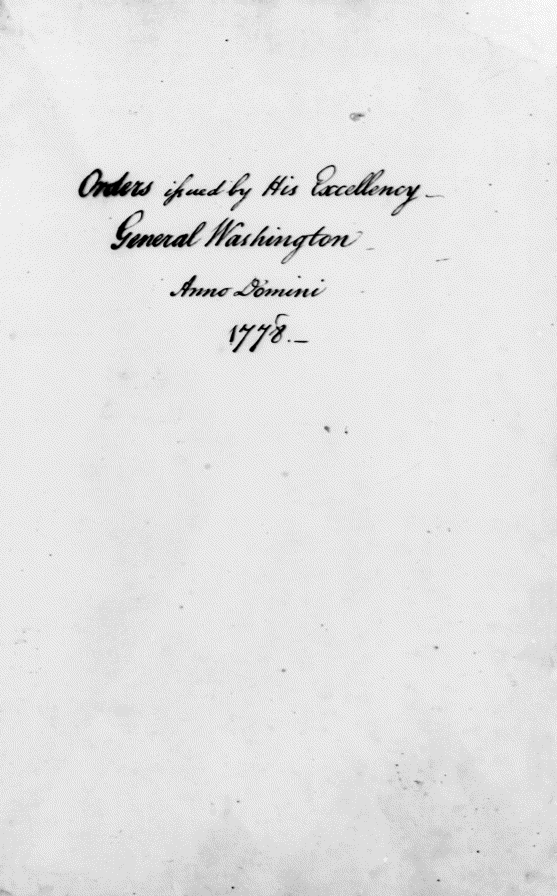
The winter of 1777–1778 was the worst of the Continental Army’s war. Roughly twelve thousand troops marched into winter quarters at Valley Forge in December. By March the army was barefoot in places, half-rationed, and decimated by smallpox, typhus, and dysentery. Estimates of mortality vary, but the most careful modern accounting puts deaths across the whole encampment at roughly 1,700 to 2,000 of the twelve thousand who marched in—about one in six or seven, most of them to disease, much of it in the spring. On 6 April 1778, with Friedrich von Steuben’s drilling beginning to put a Prussian shape on the survivors, Washington issued the day’s General Orders.
He used a phrase that, as far as our corpus shows, had not appeared in formal American military prose before. It would appear again in his correspondence four times across the next twenty years.
The Shakespeare original
It is Henry V, on the morning of Agincourt. Outnumbered by the French, his own officers wishing aloud for ten thousand more men out of England, the king walks among the troops and gives the most famous battlefield speech in English literature.
We few, we happy few, we band of brothers;
For he to-day that sheds his blood with me
Shall be my brother; be he ne’er so vile,
This day shall gentle his condition…
Band of brothers is the kind of phrase the project sets aside as common-stock English rather than counting as a clean Shakespearean attribution. By 1778, almost two centuries of circulation meant printers, schoolmasters, and clergy had all picked it up; it was part of the working vocabulary of military and civic prose by Washington’s day. Shakespeare popularised it, but the corpus can’t isolate the route by which it reached Washington in 1778 from the route by which the same phrase reached every other literate officer of the Atlantic world. The statistical check asks “is this phrase distinctively Shakespearean versus general 18th-century English?” The answer is no. The case study reads Washington’s 1778 use as register, not citation: he reached for what was at hand, and what was at hand had a Shakespearean ancestor.
1778: the worst winter
The General Orders of 6 April 1778 spend their first half on small disciplinary matters (the punishment of two soldiers for theft, an inspection schedule, the assignment of fatigue details). They close with a passage addressed to the officer corps:
The address is to the officers, not the rank-and-file. Washington was at this moment chronically worried about the bickering, the duels, and the cabal led by Thomas Conway that had nearly displaced him in his command three months earlier. The Shakespearean phrase carries the precise weight the situation demanded: a king, the night before a battle that should have been lost, telling his outnumbered men that they were his brothers. The Continental officers, the night before what could very plausibly have been the army’s dissolution, were being told the same.
1783: the Farewell Address to the Army
Five and a half years later, on 2 November 1783, Washington addressed his army for the last time. The Treaty of Paris had been signed two months earlier. He was about to ride to Annapolis and resign his commission. The Farewell Address looks back at what the army had been:
The phrase has shifted register. In 1778 it was an instruction to officers under stress. In 1783 it is a description of a fact: thirteen colonies’ soldiers did become a band of brothers. The Continental Army had held. Washington, on the threshold of retirement, is letting the phrase do its retrospective work.
1785: peacetime cosmopolitanism
Two years into retirement at Mount Vernon, Washington writes to Charles Armand-Tuffin, a French nobleman who had commanded a cavalry legion under his orders during the war and was now back in France. The letter is friendly, valedictory, and ranges over what peace might be good for:
The phrase has moved further still: from the Continental officer corps in 1778, to the army in 1783, to the whole world in 1785. Shakespeare’s small fraternity of English soldiers on a field outside Agincourt has, in Washington’s pen, become an Enlightenment-pacific image of humanity as a single family.
1798: Knox, and the partisans
Thirteen years pass. By the autumn of 1798 the United States and revolutionary France are in an undeclared naval war (the Quasi-War), and Washington has been called out of retirement at the age of sixty-six to command a hastily raised Provisional Army. He writes to his old artillery commander Henry Knox on 21 October:
Three days later, writing to William Richardson Davie about appointing officers free from French partisan sympathies, he uses the phrase again, this time defensively, as the thing partisanship would break:
The 1798 uses re-tune the Shakespearean phrase one last time. In 1778 it was an aspiration for officers under stress. In 1783 it was a description of what the army had become. In 1785 it was an image of humanity at peace. In 1798 it is a thing under threat: the kind of brotherhood Washington wants to preserve, and the kind of partisan poison he wants to keep out. Fourteen months later he was dead.
Twenty years on one phrase
1778
General Orders at Valley Forge
the Continental Army
1783
Farewell Address to the Army
looking back at the war
1785
private letter, peacetime
to Charles Armand-Tuffin
1798
back to command, Quasi-War
to Henry Knox
1798
warning against French partisans
to William R. Davie
Five uses, four different registers. The shape is the same as Adams’s tide: a Shakespearean line, retained verbatim across decades, acquiring different rhetorical functions as the life around it changes. The corpus surfaces the trace; only the reader who has the dates and the biographies can recover the second-order pattern.
Two ways of being Shakespearean
Band of brothers sits in an interesting middle position. It’s not a phrase Washington would have called a quotation. By 1778 it was the kind of phrase anyone in the officer corps might reach for. But its route into 18th-century English ran straight through Shakespeare. Every English-language speaker with literary access in the eighteenth century had encountered the St. Crispin’s Day speech. Washington owned editions of Shakespeare and attended performances of his plays in Philadelphia and New York. The word reached him by way of the playwright, even if neither Washington nor his audience would have thought to mention Shakespeare in the moment.
Most of what Shakespeare gave the Founders looks like this. Adams’s deliberate quotations are the loud part. The quieter part (the part that produces phrases like band of brothers appearing in a Continental Army General Order without anyone marking it) is harder to document case by case, but it’s the wider channel. Shakespeare became part of the air the Founders wrote in. They breathed his English without always knowing they were doing it.
▸A note on how this case study sits against the statistics, for the methodologically curiousA note on how this case study sits against the statistics
The wider research project also runs a strict statistical test on twenty-four phrases popularly attributed to Shakespeare: are they significantly more common in Shakespeare than in the Founders, after correcting for multiple comparisons? Only four pass: I had rather, flesh and blood, pound of flesh, and et tu, Brute.
Band of brothers doesn’t. By 1778 the phrase was common enough in general English that the statistical test can’t single Shakespeare out as its source against the Founders’ ordinary speech. And yet the historical route from Henry V through educated 18th-century English into Washington’s general orders is undisputed. That gap (between what the corpus statistics will mark and what historical reading recovers) is the substantive point of the case study. The fully-Shakespearean phrases survive the corpus test; the partially-Shakespearean ones travel beyond it.
See also There Is a Tide for the same “one phrase, many decades” pattern in John Adams, and Two Modes of Shakespearean Influence for the broader argument.