Essay · The substantive findings
Chapter 8 of 9
The Hamilton Silence
Two of the six Founders are dramatically less Shakespearean than the other four. Under the strict Shakespeare-only standard, after a source-level audit of two earlier false positives, Madison sits alone at the bottom of the composite ranking and Hamilton is one step above him. The contrast they create with Adams and Franklin is what makes the rest of the project’s findings mean what they mean.
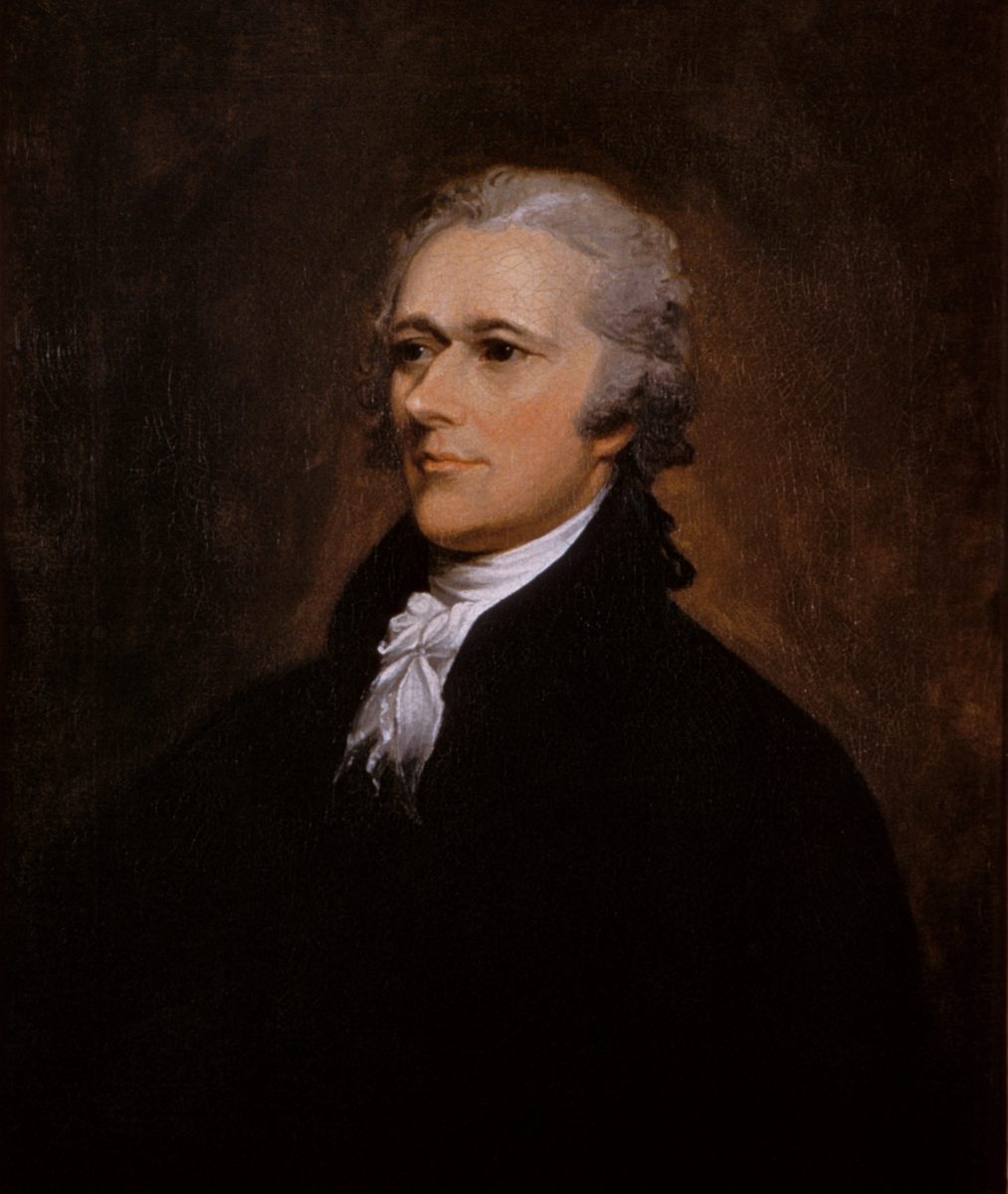
Alexander Hamilton (Trumbull, 1806).
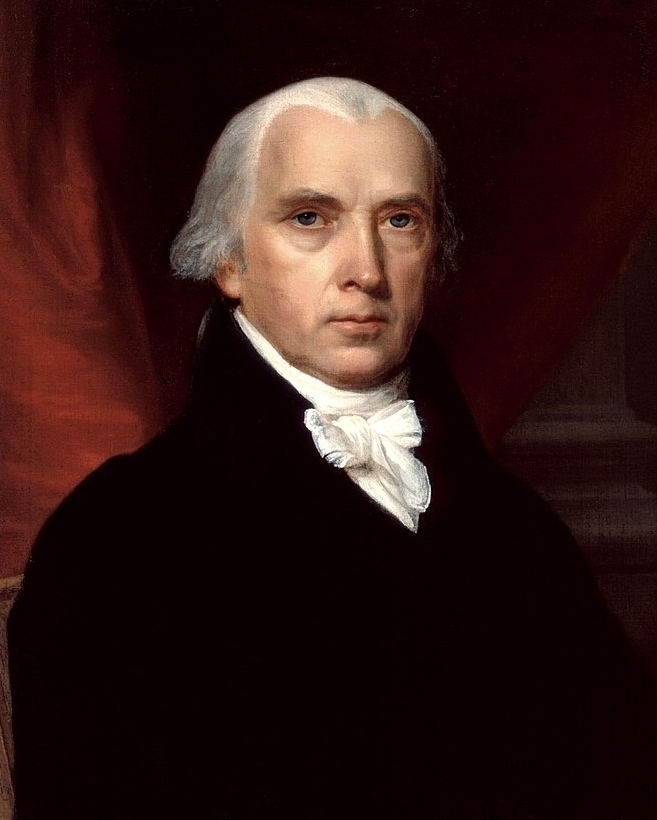
James Madison (Stuart, 1804).
The case studies elsewhere in this collection make Shakespearean inheritance feel inevitable. Adams returns five times across thirty-eight years to the same line in Julius Caesar. Washington paraphrases the St. Crispin’s Day speech at Valley Forge. Franklin writes in seventeenth-century English at the age of sixteen and never stops. A reader could come away thinking the Founders all sounded like Shakespeare in differing degrees.
They did not. Two of the six are dramatically less Shakespearean than the other four, by most measures the project applies. Their prose belongs to a different intellectual tradition. The contrast they create is what gives the Adams and Franklin findings their meaning.
Madison sits alone at the bottom of the composite ranking under the project’s strict Shakespeare-only standard (composite 0.11), with Hamilton one step above him at 0.25. Earlier in the project they tied at 0.20, but a source-level audit of Madison’s catalogue items dropped both as false positives: one was a Project Gutenberg ingest error (Talbot Mundy’s 1916 adventure novel King of the Khyber Rifles was spliced into Madison’s corpus and contributed the “I love thee, thou art” five-gram), and the other was the 1780 “tempest” reference, which described actual hurricane damage in the West Indies rather than the play. The audit cut Madison’s composite from 0.20 to 0.17; cleaning the contaminated Gutenberg texts out of the statistical corpora (methodology v3) cut it again, to 0.11, and erased most of his apparent use of Shakespeare-coined phrases along the way. The harder the project looked, the quieter the silence got. An earlier draft of this essay also treated Hamilton’s 1779 “spice of Julius Caesar or Cromwell” line as the one Shakespearean trace in his prose. The revised methodology sets that passage aside: Caesar paired with Cromwell is two historical strongmen, and the project doesn’t count Roman names as Shakespeare evidence because they reach the Founders through Plutarch and classical training too. The Shakespeare-Only Characters essay explains the criterion.
The three zeros
Across Hamilton’s entire corpus (7,007 documents and 2.21 million words spanning the Revolution, the Constitution, the Treasury years, and his death in 1804) the project’s analyses find:
Madison’s record is identical in shape. Across 3.2 million words and 8,554 documents, he never names Shakespeare, never quotes him verbatim, and shares essentially nothing of his stylistic register. The one catalogue match the project ever attributed to Madison (I love thee thou art) was the Talbot Mundy ingest error described above; the audit removed it, and nothing replaced it.
On the project’s overall ranking of how Shakespearean each Founder’s writing is, Madison finishes last. Hamilton finishes fifth, edging Madison by a small margin on candidate-echo density and on the use of Shakespeare-coined phrases; on the stylistic test under Configural Frequency Analysis, Madison actually edges him. (His Caesar invocation doesn’t help him: the strict standard sets it aside, and on the thematic measure the two men tie.) The gap between Hamilton and Madison at the bottom is small. The gap between either of them and the four Founders above is much larger. Adams and Franklin sit first or second on row after row of the matrix; Hamilton and Madison sit fifth or sixth.
And yet Hamilton had read Shakespeare
The Hamilton silence isn’t a story about ignorance. Hamilton was one of the best-read political writers of his generation. His Federalist Papers draw heavily on Roman political history: on the rise and fall of the Republic, the dangers of demagogues, the fragility of free constitutions. The Roman material he draws on reached him through Plutarch primarily, and through the wider classical education of the eighteenth century.
There are two small Shakespearean traces in his writing. The first comes in Federalist No. 75, on treaty-making powers, where Hamilton writes about why the House of Representatives is poorly suited to negotiating with foreign powers:
The word multitudinous is one of Shakespeare’s most famous coined-or-popularised inventions, from Macbeth’s line about the “multitudinous seas incarnadine” immediately after the murder of Duncan. Hamilton uses it in a treaty-clause argument, two centuries later, on the floor of what would become a national political debate.
By Hamilton’s day, multitudinous had become common enough in formal English that the project’s statistical analysis of phrases popularly attributed to Shakespeare would not flag it as Shakespeare-distinctive against the Founders’ ordinary vocabulary. Hamilton’s small Shakespearean borrowing belongs to the same category as Washington’s band of brothers: phrases that travelled from Shakespeare into general 18th-century English and arrived at the Founders without a visible Shakespeare marker on them.
The second trace comes near the end of his life. In the “Lucius Crassus” essays of 1801, attacking Jefferson’s first annual message, Hamilton paraphrases a line of Macbeth. Two traces across 2.21 million words: that is the whole inventory.
Hamilton’s 1779 letter to John Laurens, which calls General Charles Lee “a little spice of the Julius Caesar or Cromwell,” was treated in an earlier version of this essay as a Shakespeare trace. On further inspection, the project records it as ambiguous. Caesar paired with Cromwell is two historical strongmen, not a Shakespeare reference. The same applies to the dinner-party line Jefferson recalls in 1811, where Hamilton names Caesar as the greatest man who ever lived. By the late eighteenth century, Brutus, Caesar, and Cassius reached the Founders through multiple channels (Plutarch, classical education, general political culture) as much as through the Roman plays. The Shakespeare-Only Characters essay explains why the project sets these passages aside rather than counting them as Shakespearean inheritance.
Hamilton’s silence is therefore close to thorough. Madison’s is the same. Neither produced an unambiguously Shakespearean character-type invocation in his surviving correspondence. Neither named the playwright. The Federalist No. 75 “multitudinous” and the 1801 Macbeth paraphrase are the only Shakespeare-attributable items the project finds in Hamilton’s prose, and the first is exactly the kind of culturally-diffused word that arrived at the eighteenth century without a visible Shakespeare marker on it.
Why he sounds nothing like Shakespeare
Hamilton’s intellectual models were the modern political philosophers: David Hume on factions, Montesquieu on the separation of powers, Blackstone on the common law, Adam Smith on commerce, the classical historians on Republican decline. His prose is the prose of those traditions: administrative, philosophical, lawyerly, abstract. Sentences in Federalist No. 78, No. 70, No. 15 sound like Locke or Hume in cadence: long, qualified, structured around argument. They do not sound like a play.
And his subject didn’t reward Shakespearean borrowing. Hamilton was helping design something that didn’t exist in Shakespeare’s political world. The federal executive, the Treasury Department, the relationship between the central government and the states, judicial review, public-credit management. None of these had Shakespearean vocabularies attached to them. The political world Hamilton was constructing required new English. So he built it from his own sources rather than reaching for an older one.
Madison’s case is similar in structure but different in flavour. His prose is the most administratively careful in the corpus, full of his characteristic abbreviations (agst, govt, congs) and dense with the procedural detail of legislative work. He keeps his writing efficient and undecorated. Whether he reached for Shakespeare for occasional ornament we cannot know; what the corpus shows is that in 8,554 surviving documents he never did.
Why this absence is the third major finding
The temptation in a project of this kind is to find Shakespeare everywhere and call it influence. The Adams case studies show careful, repeated Shakespearean engagement; the Franklin case study shows an entire register absorbed at a young age. If Shakespearean inheritance were simply an eighteenth-century inevitability (the background music of every educated American’s prose) we would expect to find Adams and Franklin levels of Shakespearean material in every Founder.
We don’t. We find two Founders who behaved that way (Adams and Franklin), two who took it in smaller doses (Jefferson and Washington), and two who effectively opted out. The differences track biographical and intellectual choice cleanly. Adams treated Shakespeare as applied moral psychology: useful for understanding people. Franklin learned to write English from older sources and never updated. Washington picked up a few set pieces, the kind that floated freely through officer culture. Jefferson kept Shakespeare on his library shelves and reached for him in specific moments. Hamilton and Madison reached for different sources entirely.
That distribution, two heavy users, two moderate, two much smaller, is what the project’s data shows. The two-modes finding in the Adams/Franklin essay and the character-as-type finding in the Shakespeare-Only Characters essay describe what Adams, and to a degree Franklin and Jefferson, did with the Shakespearean material available to them. The story this essay tells is the harder one. Adams chose to engage Shakespeare densely. Hamilton and Madison chose not to engage at all in any way the corpus can detect. The choices are visible in the data.
That makes their absence the third pillar of the project’s argument. Shakespearean inheritance into American political prose wasn’t automatic. It was selective. The Founders who took it took it for specific reasons. The Founders who didn’t had specific reasons not to.
A footnote on the corpus
One thing the silence is not. It is not evidence that Hamilton or Madison didn’t read Shakespeare. Hamilton owned the plays and, by some accounts, could quote them in conversation; Shakespeare appears in Madison’s library lists too. What the silence describes is the writing: what each man chose, sentence by sentence, to put on the page. Their writing chose other models. Adams’s and Franklin’s writing chose Shakespeare. The choices are real and recoverable from the corpus. They are also, taken together, more interesting than a single uniform pattern of inheritance would have been.
See also Two Modes of Shakespearean Influence, The Shakespeare-Only Characters, and Reading by Generation, which between them explain why Hamilton’s formative reading happened on the wrong side of the 1765 cut.