Essay · The substantive findings
Chapter 5 of 9
The Shakespeare-Only Characters
Six character invocations in the corpus that can only have come from Shakespeare. All Adams. Across forty-two years. A smaller finding than the data first seemed to support, and one the project records honestly.
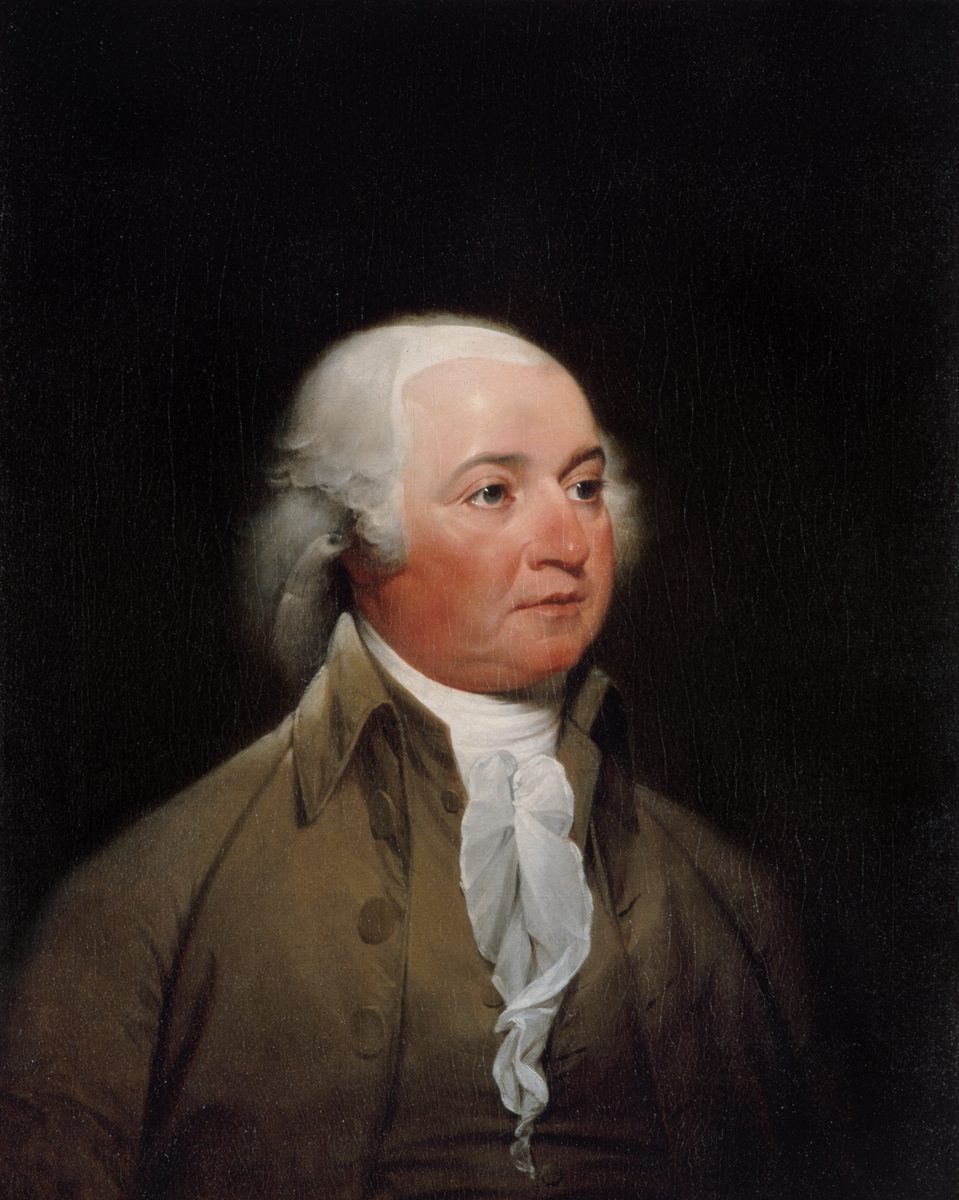
John Adams (Trumbull, c. 1792).
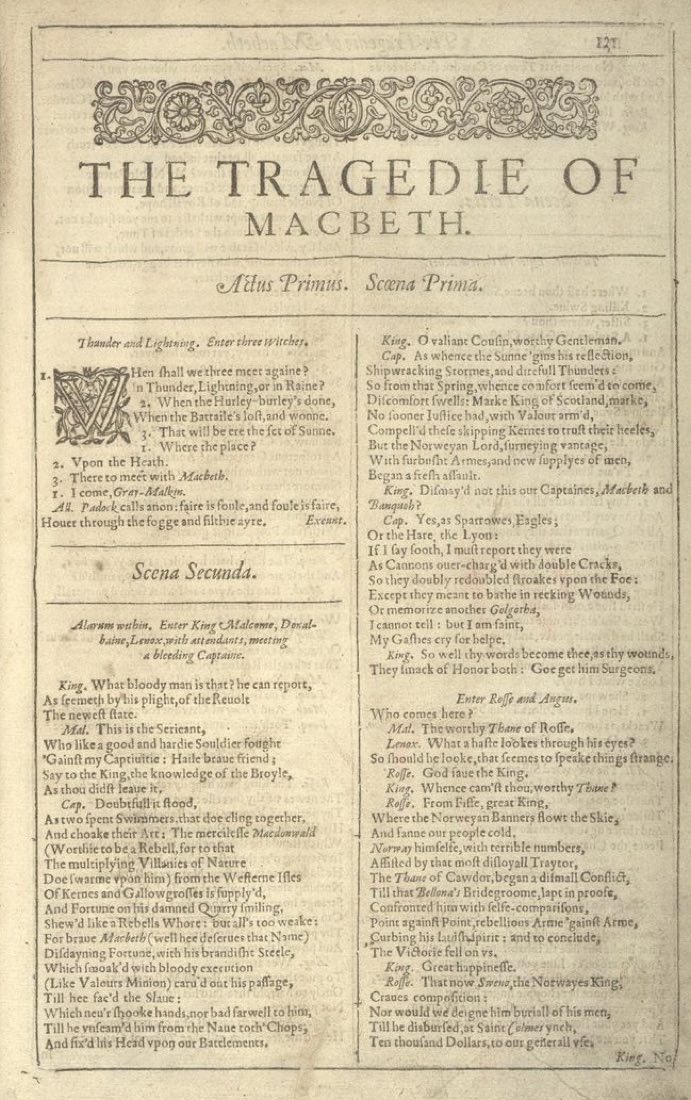
First Folio: Macbeth.
An earlier draft of this essay made a larger claim. The project’s data on character-as-type invocations showed thirteen passages where a Founder named Brutus, Caesar, or Cassius as a political type. That looked, at first, like the Roman plays of Shakespeare doing real political work in the Founders’ correspondence. The claim was tempting because Julius Caesar is the best-attested Shakespeare reference in Adams’s catalogue, and Brutus and Caesar are characters every eighteenth-century gentleman knew.
The claim doesn’t hold up at the level of attribution. Brutus, Caesar, and Cassius reached the Founders through multiple channels. They are Plutarch’s characters before they are Shakespeare’s. They are the staples of an eighteenth-century classical education before they are the names of characters in a play. When Hamilton writes in 1779 that Charles Lee has “a little spice of the Julius Caesar or Cromwell in him,” he is reaching for two historical generals paired by their ambition, not for a Shakespeare line. The project cannot cleanly count those passages as evidence of Shakespearean inheritance.
Tightening the criterion
Set the Roman names aside. Ask the same question of the thematic-allusion data again, with a stricter rule: do any Founders, in their political prose, invoke a character that can only have come from a Shakespeare play? A character Shakespeare invented, in other words, with no plausible historical-source alternative?
The result is six passages across the entire corpus. All of them are John Adams. They span from 1776 to 1818, the same forty-two-year window his other Shakespearean material covers.
The Founders Hamilton, Madison, Franklin, Jefferson, and Washington produce, between them, zero such invocations. The Roman names they use (Brutus, Caesar, Cassius) reach them through classical training as much as through Shakespeare, and the project records that ambiguity rather than overclaiming.
1776: Harrison as Falstaff
Adams writes in his diary in 1776 about Benjamin Harrison, a Virginia delegate to the Continental Congress whom Adams disliked. He calls Harrison a kind of person, by way of a character borrowed from Henry IV and The Merry Wives of Windsor:
Falstaff is unambiguous. No historical Falstaff exists. Shakespeare invented him. When Adams calls Harrison “another Sir John Falstaff,” he is reaching for a character he could only have got from the plays. The figure does the political work of compressing cowardice-plus-bluster-plus-disreputable-charm into a single recognisable name.
1781: the baseness of Shylock
Five years later, with the Revolution still going on, Adams is writing about Dutch reluctance to recognise the new American republic. He reaches for a different Shakespeare character to describe what would happen if the Dutch sacrificed America for their own peace:
Shylock is also Shakespeare’s invention. No historical Shylock. Adams is using the figure to do moral work: the usurer-Jew of Venice, in the eighteenth century’s reading of the play, was the type of mercenary calculation sacrificing principle. (The reading is uncomfortable to modern eyes; the period’s anti-Jewish framing is part of why Shylock had become available as a type at all. The essay records what Adams did, not what he should have done.)
1805: Falstaff, Pistol, Nym, Peto, Fluellin
Twenty-four years later, Adams in retirement writes a long letter on the historical instruction the Founders should draw from the Wars of the Roses. He warns that the Lancastrian-Yorkist conflict is a dense political education for a young republic and that the reader must keep his attention on the politics rather than the comedy. Then he names the comedy:
Five Shakespearean characters in one line. Falstaff, Pistol, Nym, Peto, and Fluellin are all from the Lancastrian history plays. None of them is a historical figure. Adams is using the cluster to characterise the type of distraction the comic subplot offers, while urging his correspondent to read through the comedy to the political substance. It is the densest single Shakespeare-only invocation in the corpus.
1807: Athens as a perfect Hotspur
Two years later Adams writes about Athenian democracy. He wants to make the point that democratic regimes are at least as ambitious for war as monarchies are. He reaches for a character from the same Lancastrian history plays:
Hotspur is the one passage in this set with some historical ambiguity. Henry Percy was a real fifteenth-century figure, killed at Shrewsbury in 1403. By 1807 the type Adams reaches for, the impatient warrior who lives for the next battle, was Shakespeare’s shaping of the figure, not Percy’s historical record. The Percy of medieval chronicle is not a political-type vocabulary the way Falstaff or Shylock is. Adams is reaching for the play.
1812: Shylock returns
Five years later Adams is writing about American banking and credit. The question is who should answer the broad moral question of whether public credit itself is good or evil. Adams runs through several possible authorities and rejects each in turn:
Adams is using Shylock as a class-noun for the usurer generally. The same figure as in 1781, deployed thirty-one years later for a domestic-economic argument rather than a diplomatic one. The Shakespeare character has become a political-economic vocabulary.
1818: like Lady Macbeth
The last unambiguously-Shakespearean invocation in Adams comes in the 1818 letters reflecting on the Revolution from the vantage of his eighties. Adams writes about how the colonists’ affection for England turned into the revolutionary movement:
Adams is naming the character and quoting the line in the same sentence. The “dash their brains out” phrasing is from Macbeth Act 1 Scene 7, where Lady Macbeth tells her husband she would have killed their child rather than break a promise. Adams turns the line into the figure of a mother country willing to destroy her colonial children to keep an empire intact. The political reading is doing the work the figure could not do without Shakespeare.
What survives the tightened criterion
Six passages, all Adams, across forty-two years. Two Falstaffs (the 1776 single use and the 1805 cluster). Two Shylocks. One Hotspur. One Lady Macbeth. The plays they come from are Henry IV, Henry V, The Merchant of Venice, The Merry Wives of Windsor, and Macbeth. The Lancastrian history plays end up well-represented after all, but as character sources rather than as quotation sources. The comic subplot characters (Falstaff and his circle) and the figure of Hotspur do most of the work.
This is a smaller finding than the previous version of this essay claimed. It still tells a real story. Adams alone of the six Founders extended his Shakespeare engagement into the realm of political character-type. He named a Virginia congressman a Falstaff in 1776. He named an English mother country a Lady Macbeth in 1818. The other five Founders, when they reach for political character-as-type comparisons in their prose, reach for Roman names whose Shakespearean credit cannot be cleanly distinguished from Plutarch’s or from general eighteenth-century classical education.
The Hamilton Silence essay’s framing was tightened in light of this revision. Hamilton’s “spice of Julius Caesar or Cromwell” passage is no longer treated as a Shakespeare exception in his record. The historical Caesar paired with the historical Cromwell is what the sentence is doing, and the project records it as ambiguous between Shakespeare and Plutarch rather than as evidence of Shakespearean reach.
For the underlying data, including the Caesar-Brutus passages set aside in this revision, see the Thematic Allusions explorer. For the case studies on Adams’s specific Shakespeare passages, see Lady Macbeth and Herod and the 1758 Macbeth Study.