Case study
The 1758 Macbeth Study
One diary entry. Sixteen quotations. The 23-year-old Adams thinking through Macbeth in real time.
Finding. In a single diary entry titled Shakespeare’s Characters and Figurative Language (late 1758), the project’s catalogue finds sixteen direct quotations from Macbeth: the densest Shakespeare reading event in the entire corpus across all six Founders, and the foundation of the Macbeth thread that runs through Adams’s writing for the next sixty years.
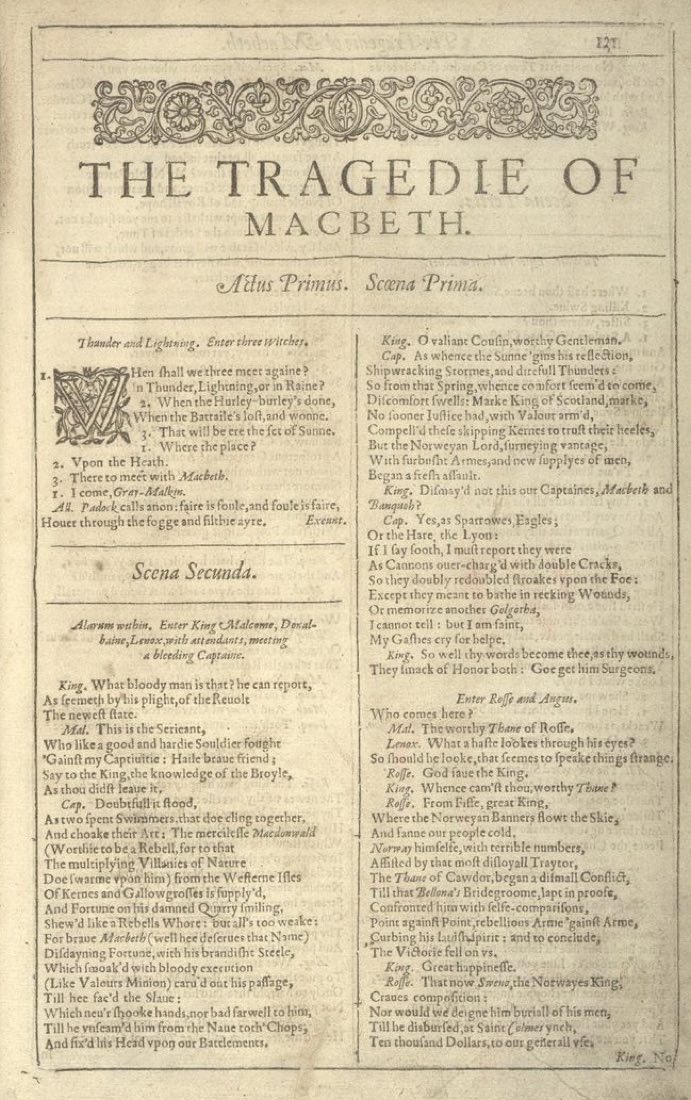
The 1758 diary entry titled Shakespeare’s Characters and Figurative Language is, by the project’s measure, the densest single moment of Shakespearean reading in the entire six-Founder corpus. In one document (running to roughly a thousand words of Adams’s own writing interleaved with sixteen verbatim passages from Macbeth) the 23-year-old Adams works his way through the play, transcribing the passages that struck him and writing his own commentary in the margin. It is a piece of historical reading captured live on the page.
The entry is dated “October-December 1758,” which is to say Adams probably wrote it over several sittings. He is in his father’s house in Braintree, recently admitted to the Massachusetts bar, building a law practice, and reading prodigiously. He has just turned twenty-three. Nearly forty years before he will become President, he is doing what every literate young man of his generation was supposed to do, and very few left such complete records of: sitting alone with a copy of Shakespeare and a notebook, and thinking his way through.
What the diary entry captures, and what the catalogue flags as sixteen distinct direct quotations, is the difference between reading Shakespeare and working Shakespeare. Adams isn’t reading the play; he’s taking it apart. The cascade below is the first six of those sixteen passages, in the order they appear in his diary, not the order they appear in the play. Which order Adams chose to copy them in is itself a story about how a young lawyer reads dramatic verse for the first time.
The cascade, in his order
1.Adams opens with Macbeth's reaction to news of his wife's death, the 'Tomorrow' soliloquy, Act 5 Scene 5.
2.Adams's gloss: 'Here he compares Life, 1st to a Candle, then to a Shadow, an Image taken from scripture, then to a Player on the stage…' He has read this passage as a string of similes nested inside a single mood.
3.Then the omens around Duncan's murder. Adams works through Macbeth Act II Scene IV systematically.
4.Adams continues with Rosse's report of Duncan's horses.
5.Adams's quotation glides into Act II Scene III, the witches' weather, the unnatural night of the murder.
6.The 'Sleep no more' passage, Macbeth 2.2. Adams's commentary now in the margin: 'Mackbeths Imagination was [struck?] and afraid, was as lively and teemed with Notions…'
The diary continues for ten more verbatim Macbeth passages after these. The full catalogue lists sixteen in total. Adams writes his own analytical glosses between them: he is, in real time, building his theory of how Shakespeare layers his images, how Lady Macbeth and her husband and Iago all belong to the same class of “Characters of Fiends, not of men.” The same speeches he is studying here at twenty-three will surface in his writing for the rest of his life.
What sixty years of Shakespeare flow from this entry
Every other Adams Shakespeare reference in the project catalogue is, in some sense, an echo of this 1758 entry. The Lady Macbeth thread (I have given suck) that Adams returns to in 1765, 1782, 1799, and 1818 is the same Lady Macbeth Adams is reading here, twenty-two years younger. The Tomorrow soliloquy that Adams invokes in 1813 to attack a political opponent (“a Tale told by an Ideot full of sound and fury Signifying Nothing”) is exactly the passage at the top of his 1758 cascade. The Macbeth-banquet-scene image about brains being out and men rising again with murders on their crowns is one Adams will quote across his life. The Macbeth-soliloquy on sleep (Sleep no more) is one he will paraphrase to his children.
The 1758 cascade, in other words, is the source layer of the Lady Macbeth, Tomorrow, and Sleep threads that criss-cross Adams’s prose for the next sixty years. Without this single multi-session diary entry, three of the project’s case studies would lose most of their material. With it, you can almost watch the citational habit form.
Other reading episodes in the catalogue
The 1758 Macbeth study is the densest reading episode in the corpus, but it is not the only one. The catalogue records four other Adams documents that each contain three or more direct Shakespeare quotations:
- 1758 Othello to Cranch. A letter to Richard Cranch the same year as the Macbeth diary entry, with six Othello quotations. Adams as a young lawyer trying his hand at literary discussion in a letter to a friend, working from Othello the way he worked from Macbeth in the diary.
- 1794 Tempest to Abigail. A letter to Abigail, 17 May 1794, with eleven Tempest quotations. Adams is fifty-eight, Vice President, in Philadelphia. The letter is a meditation on a play he has been re-reading; the citation density rivals the 1758 cascade.
- 1805 Henry V/VI to John Quincy. A letter to his son, 20 January 1805, with five quotations from the Henry plays. Adams in retirement, guiding his son’s political reading.
- 1812 Julius Caesar to Smith. A letter to William Stephens Smith, 15 October 1812, with three direct Julius Caesar quotations. The play that will furnish Adams’s late masterpiece quotation (the Cry havoc letter to his grandson; see the Cry Havoc case study).
Five reading episodes, all Adams. No comparable episode exists for any other Founder in the catalogue. The 1758 Macbeth study is the originating moment; the four others are continuations of a habit that the diary entry made.
The sixteen verbatim Macbeth quotations are also not the only Shakespearean material Adams was working through in 1758. Below the catalogue’s seven-word strict threshold, the candidate-echoes scan recovers more from his 1758 documents: full of sound and fury and sleep the innocent sleep (both Macbeth, from this same diary entry), plus farewell the neighing steed (Othello, from the Cranch letter that frames the Othello reading episode that year). The Shakespearean density of Adams’s 1758 reading is even higher than the catalogue alone shows.
Read about the threads that flow forward from this entry in the Lady Macbeth and Herod case study, see the same dot cluster from the data side at the densest point of the Quotation Timeline, or read the original diary entry on Founders Online.