Case study
Cry Havoc, 1822
Adams at eighty-six reaches for Antony’s line over Caesar’s corpse to characterise the political theology of his long-dead friend Benjamin Franklin. The letter is to his grandson.
Finding. On 22 February 1822, four years before his own death, John Adams writes to his grandson George Washington Adams about Franklin’s constitutional doctrine. Franklin had been dead for almost thirty-two years. Adams reaches for Antony’s line from Julius Caesar (“Cry havock, and let slip the dogs of war”) to characterise what Franklin’s political arguments would produce if anyone followed them. It is one of the last verbatim Shakespeare quotations in his life, and the most cutting. The eighty-six-year-old Adams is teaching his grandson political theory by way of a Shakespearean threat, applied to a quarrel half a century old.
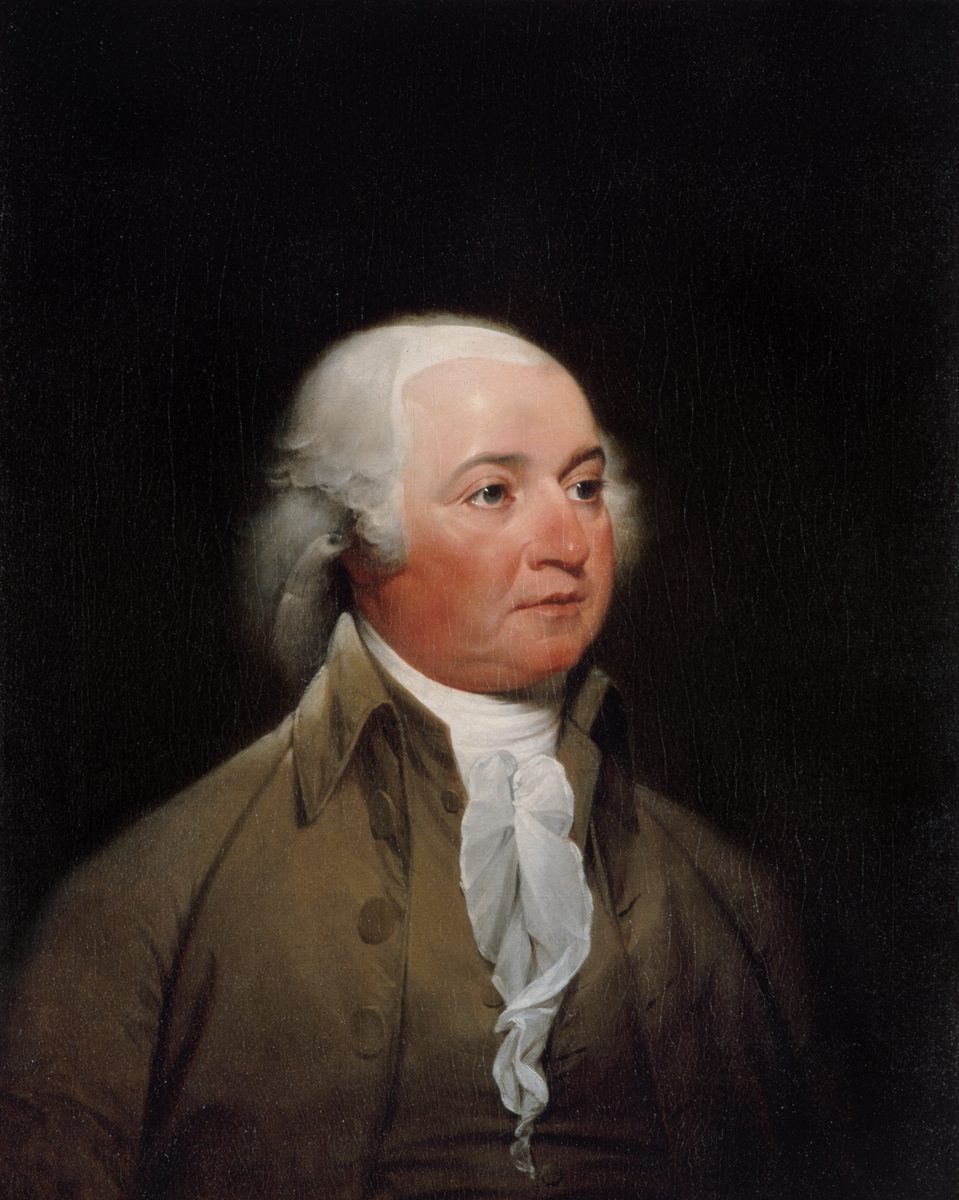
Adams was eighty-six. Abigail had been dead for about three and a half years. Franklin had been dead for thirty-two. Jefferson, in Monticello, was still alive but corresponding less; the two old rivals had renewed their friendship over the years 1812–1820 in one of the more remarkable letter-exchanges in American history. His daughter Nabby had been dead for eight and a half years. He had outlived almost everyone he had fought alongside.
On 22 February 1822 he wrote to his grandson, George Washington Adams, the twenty-year-old eldest son of John Quincy. The letter is, on its face, an uncomplicated grandfatherly note. Adams gives the boy some family news, sends greetings from various aunts and cousins, and then catches himself thinking about constitutional design. Somewhere in the middle of the letter, in the middle of a discussion about whether legislatures should have one chamber or two, he reaches for Shakespeare.
Antony, over Caesar’s body
The line is from Act 3 Scene 1 of Julius Caesar. Caesar has just been assassinated by the conspirators (Brutus among them). Mark Antony arrives, surveys the corpse, and pretends to extend a hand of friendship to the assassins. Then they leave him alone with the body. Antony bends down, speaks to the dead man, and makes a prophecy:
And Caesar’s spirit, ranging for revenge,
With Ate by his side come hot from hell,
Shall in these confines with a monarch’s voice
Cry ‘Havoc!’ and let slip the dogs of war…
It is among the most-quoted speeches in the play. The vow is a curse: that the murder of Caesar will unleash civil war on the country that allowed it. Antony is keeping a promise to a dead man at the cost of the republic.
Adams at eighty-six
The Adams passage uses the line as a description of what, in his view, Franklin’s political doctrine would produce if anyone took it seriously:
Three things to notice. First, Adams spells the word havock. That spelling matches the First Folio and was also still in eighteenth-century circulation; it is consistent with Adams having the play at hand or in memory, though it doesn’t by itself prove direct consultation. Second, he extends the metaphor: Antony’s “dogs of war” civil and Foreign, and then a despot who will “lay the dogs prostrate with his language”. The political prediction is grim and specific. Third, the conclusion: that constitutions will dissolve into “thin Air.” The phrase is a plausible echo of The Tempest 4.1 (“melted into air, into thin air”), Prospero’s speech about the impermanence of human works. “Thin air” had become common English by 1822, so the attribution is less secure than the Antony quotation; the project reports it as a likely Tempest echo rather than a verified one.
What the quarrel was about
Why was the eighty-six-year-old Adams still arguing with Benjamin Franklin in 1822, more than thirty years after Franklin’s death? The answer is constitutional architecture.
Adams spent much of his post-war life arguing for bicameral legislatures: an upper house and a lower house, each checking the other. His three-volume Defense of the Constitutions of Government of the United States of America (1787) is essentially a long defence of bicameralism against the unicameral models popular in the early state constitutions and in the European republican tradition. The most influential American advocate for the unicameral approach had been Franklin, who helped design the Pennsylvania state constitution of 1776 with a single legislative chamber.
Pennsylvania’s 1776 constitution was, by 1790, widely considered a failure. The single-chamber legislature had produced exactly the kind of factional swings Adams predicted; the state replaced the constitution in 1790 with a bicameral one. Franklin had died the same year. But the broader European debate about whether the working classes needed legislative protection from the wealthier classes (Adams’s view, via Polybius and Harrington) or whether all citizens should deliberate together as one body (Franklin’s view, in the Pennsylvania mode) was ongoing. Adams suspected that his grandson’s generation was forgetting the case he had spent his life making.
So in February 1822, writing to his grandson about Alexander (almost certainly Alexander Hill Everett, a diplomat the family knew) who had been too enthusiastic about Franklin’s legislative ideas, Adams reaches for Antony. Franklin’s doctrine, applied, unleashes the dogs of war. Civil and foreign. Until a despot arrives to flatten everything.
Why this particular line
Adams had a library of well-thumbed Shakespeare. He could have reached for any number of lines to indict Franklin’s constitutional doctrine. He picked Antony over Caesar’s body.
The choice carries its meaning in the surrounding scene. Antony is making this speech precisely because the people he is talking to are not in the room. Brutus and Cassius have just left. Antony is alone with the dead man; the speech is a private vow turned public threat, delivered in the absence of his enemies. Franklin had been dead for thirty-two years when Adams wrote his 1822 letter. The political opponent Adams is arguing with cannot answer back. The Shakespearean line carries that fact in its bones.
It also carries a darker note. Antony’s prophecy comes true in the play: civil war does break out, the Republic does fall, Augustus does arrive. The line predicts not just chaos but the despotism that follows the chaos. Adams’s application is exact: Franklin’s doctrine, he writes, produces havoc and a despot. The Shakespearean structure of catastrophe-then-tyranny is the structure Adams is forecasting for any American republic that follows Franklin’s constitutional path.
The end of the citational arc
This is one of the last verbatim Shakespeare quotations in John Adams’s life. Across the project’s passage-level catalogue, he produces sixty-one direct Shakespeare quotations (HIGH and MEDIUM confidence) spread across sixty-four years of writing. The first cluster is the 1758 diary entry, in which the twenty-three-year-old transcribes long passages of Macbeth and Othello. The last clusters are in the 1810s and early 1820s: the Tide speech (in 1812 and 1814), the Romeo and Juliet reference to John Randolph (in 1810), the Henry VI lines about the Wars of the Roses (in 1805 and 1812), and finally this Cry Havoc passage in 1822.
He died on 4 July 1826. As far as the corpus shows, Shakespeare was with him to the end. The construction is the same as it was sixty-four years earlier in the Braintree diary: a Shakespearean line, accurately quoted, applied to a specific human situation. The applications got more political and more cutting with age. The habit didn’t change.
See also There Is a Tide, Methinks I Hear You, and Band of Brothers at Valley Forge. Together with this one, they form the Adams citational arc that spans 1758 to 1822. The companion absorbed-mode finding is in ‘Tis: Franklin’s Signature Contraction, and the broader argument is in Two Modes of Shakespearean Influence.