Case study
Methinks I Hear You
A small rhetorical machine John Adams borrowed from Shakespeare and never gave up. Four sentences across thirty-two years, all built on the same imaginary device.
Finding. John Adams uses the word methinks only five times in his entire surviving writing, an unremarkable rate compared to Benjamin Franklin, who uses it more than thirty times more often. The finding isn’t volume. Four of Adams’s five uses follow the same Shakespearean construction (methinks I hear) deployed across 32 years to put imagined words in his reader’s mouth. He uses it at twenty in his private diary, at thirty-nine to political opponents, at forty in correspondence to a comrade, and again at fifty-three. The same rhetorical machine, same inheritance, four completely different audiences.
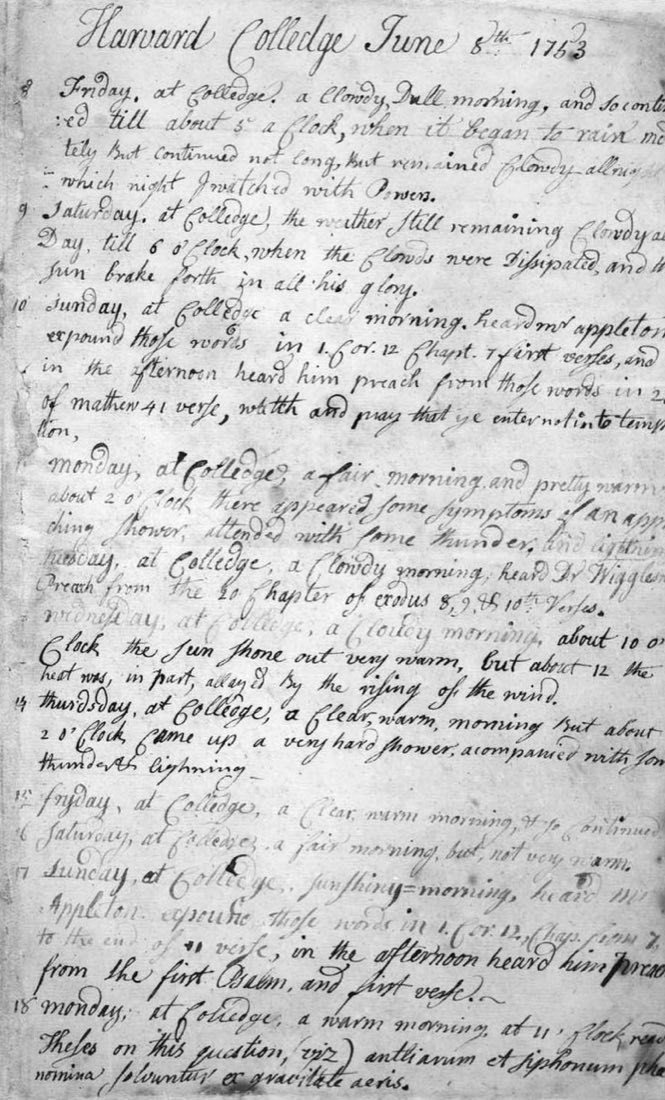
The construction is early-modern dramatic register that Shakespeare shares with his contemporaries rather than something he invented. Methinks as a verb form was standard English by 1600; methinks I hear and its sibling methinks I see are common in the prose and drama of the period. Shakespeare uses the locution fifteen times across his plays. Hamlet, talking to Horatio in Act 1 Scene 2:
My father — methinks I see my father.
(Horatio.) O, where, my lord?
(Hamlet.) In my mind’s eye, Horatio.
It’s a small machine for a specific job. The speaker invokes a perception that hasn’t happened ( I think I see / hear) in order to summon someone who isn’t there. Hamlet uses it to bring his dead father into the room. Cleopatra uses it (in Antony and Cleopatra 5.2) to summon dead Antony: “Methinks I hear Antony call.” Volumnia, in Coriolanus 1.3, uses it to bring her son into his mother’s sitting room from a battlefield miles away. Throughout Shakespeare the construction is a way to give absent voices presence, in front of an audience, without breaking the rules of the scene.
John Adams, a twenty-year-old schoolteacher in Worcester, Massachusetts, reading law on the side in 1756, picks up the construction and uses it for the next thirty-two years to put words in his correspondents’ mouths.
1756: the private diary
The first use we have appears in a diary entry of 15 March 1756. The twenty-year-old Adams is keeping school in Worcester and reading by candlelight. The diary entry begins with a strange financial fantasy (a thousand pounds a year, what he’d do with it) then catches itself. Adams anticipates the reader (perhaps an imagined future reader of his own diary, perhaps just himself) objecting that this is unbecoming. He puts words in that imagined reader’s mouth:
The construction is doing its Shakespearean job exactly. There is no one in the room. Adams is twenty, in a private diary, and he is summoning an imagined interlocutor in order to argue with him. He learned the trick from Hamlet talking to Horatio.
1775: from soliloquy to political polemic
Nineteen years later Adams is writing one of the most-read political essays of the pre-Revolutionary period: his “Novanglus” letters, addressed publicly to the Inhabitants of the Colony of Massachusetts-Bay, defending the colonial cause against the loyalist arguments of Daniel Leonard (writing as “Massachusettensis”). The machine returns, this time to put words in the mouth of Lord North, the British prime minister:
The word soliloquy tells you Adams knows exactly what he’s doing. He is staging an imagined Shakespearean scene for his readers (complete with stage directions) in which a British minister speaks his real political motives out loud. Lord North isn’t there. The reader isn’t there either. The whole construction is two invocations: methinks I hear, and then the imagined soliloquy itself.
1776: mid-Revolution, ventriloquising a friend
The next April, with the Revolution underway and Adams in Philadelphia helping draft the Declaration, he writes a letter to his old friend James Warren in Massachusetts. The colonies are arguing about whether to declare independence, what kinds of state governments to form, and whether Congress should first invite the colonies to assume governments of their own. Adams anticipates Warren’s likely objection, and the machine surfaces again:
The same construction is doing different rhetorical work again. In 1756 the invented interlocutor was Adams arguing with himself. In 1775 it was a hostile minister whose political plans Adams wanted to expose. In 1776 it’s a sympathetic friend whose practical objections Adams wants to anticipate and answer. The shape of the device hasn’t changed at all.
1788: a quiet letter to his son-in-law
Twelve more years pass. The Revolution is over. The Constitution has been ratified. Adams is about to become the first Vice President of the United States. He is fifty-three. He writes to his son-in-law William Stephens Smith on 11 November 1788. The new Federal government will need a place to seat itself, and Adams is gossiping about possible locations. He imagines what Smith will say back, and writes what he imagines into the letter:
Adams is fifty-three, the second-highest officer in a not-yet-existent republic, writing to a relative about who ought to be where in the new capital, and the way he reaches for what his son-in-law will say back is the same way the twenty-year-old in the Braintree diary reached for it thirty-two years before. The construction never left him.
Thirty-two years on one phrase
1756
private diary, age 20
(to himself)
1775
public anti-British essays
Inhabitants of Massachusetts
1776
Revolutionary correspondence
James Warren
1788
private letter, age 53
William Stephens Smith
What makes the pattern interesting is its specificity. Adams doesn’t use methinks often. Plenty of his contemporaries use it more (Franklin reaches for the word constantly). But Adams’s uses cluster around one specific rhetorical construction (methinks I hear + a verb of speech) doing one specific job (putting imagined words in someone else’s mouth). The construction comes from Shakespeare, who uses it the same way to summon dead fathers and absent lovers and far-away sons.
The Adams Shakespeare-as-text mode shows up everywhere in his writing. He quotes lines, names characters, references plays. But what this case study really documents is something narrower and stranger. Adams not only quotes Shakespeare; he uses Shakespeare’s rhetorical machinery. The small device Shakespeare made unforgettable by using it to bring a ghost into a scene, Adams reaches for in his diary at twenty, in public polemic at thirty-nine, in war-time correspondence at forty, and in family gossip on the eve of the vice presidency at fifty-three. The words are different each time. The shape of the construction is identical.
And the broader word, briefly
For completeness: the word methinks itself was already archaic by 1750 and effectively extinct in 18th-century American English. The Founders use it at low rates in their writing (one occurrence per million words or fewer, on average). The one exception is Franklin. Franklin uses methinks at 36.3 per million words, roughly thirty times the rate of any other Founder.
That’s a different story, told in ‘Tis: Franklin’s Signature Contraction: Franklin absorbed old-fashioned English so thoroughly at sixteen that it never left his prose, including this particular old word. Adams’s relationship to methinks is the opposite kind of inheritance: not the constant background hum, but four deliberate deployments of a single Shakespearean construction across the entire arc of his adult life.
See also There Is a Tide and Band of Brothers at Valley Forge: the same pattern of one phrase across many decades, in Adams and Washington respectively. The companion essay is Two Modes of Shakespearean Influence.