Case study
Lady Macbeth and Herod
A single Shakespearean speech, reached for four times across fifty-three years.
Finding. John Adams returns to Lady Macbeth’s “I have given suck” speech from Macbeth 1.7 four separate times between 1765 and 1818. In 1782 he pairs it with biblical Herod to figure England’s war. In 1818 the same speech becomes his definition of the American Revolution itself.
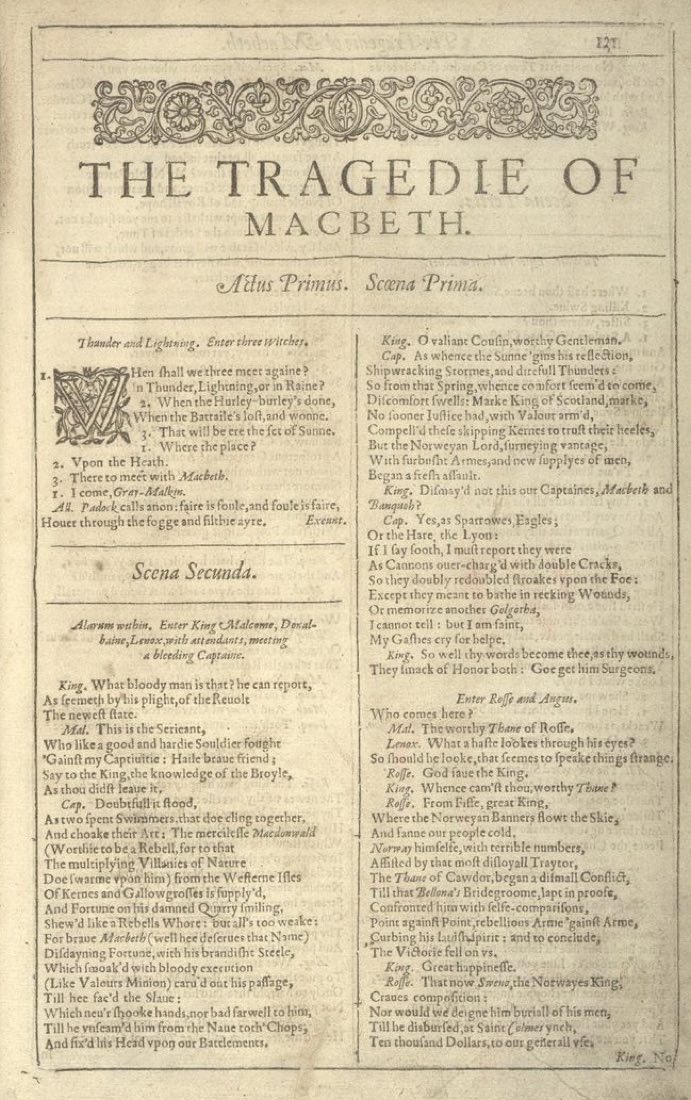
Of all the passages of Shakespeare that John Adams ever quoted, the one he returned to most often, across the most years, and in the most different moods, is the one no-one would have predicted: Lady Macbeth’s vow that she would, if she had sworn to it, smash her own infant’s skull. It is one of the darkest speeches in the canon, and Adams carries it with him from age twenty-nine through age eighty-two.
The line he kept returning to is the one Lady Macbeth uses to steady her husband’s nerve in Act 1, Scene 7, the moment before the murder of Duncan. She is reproaching him for wavering, for being less resolute than she is. If he broke his vow, she says, she could break a worse one of her own:
I have given suck, and know
How tender ’tis to love the babe that milks me:
I would, while it was smiling in my face,
Have pluck’d my nipple from his boneless gums,
And dash’d the brains out, had I so sworn as you
Have done to this.
Two centuries later this passage is still read as one of the most disturbing in Shakespeare. Adams read it that way too. He called it, in 1765, the kind of image “I cannot think of without horror.” And then he kept reaching for it.
1765
Canon and Feudal Law
Pamphlet, age 29
1782
England's war as Lady Macbeth
to Philip Mazzei
1799
rewritten as parental advice
to son Thomas
1818
the moment of the Revolution
to Hezekiah Niles
Evidence types across the four passages. The four uses are not the same kind of Shakespeare reference, and the project labels them accordingly:
- 1765: a named reference in Adams’s Dissertation — he names the character and discusses the image without quoting the line verbatim.
- 1782 & 1799: direct quotation and close paraphrase — Adams reproduces the “dash the brains out” phrasing accurately enough that the strict catalogue marks both as HIGH-confidence Macbeth matches.
- 1818: thematic invocation — Adams calls England “a cruel Beldam willing, like Lady Macbeth, to dash their Brains out,” deploying the character as a political type rather than as a literary citation.
1765: the first sighting
Adams encounters the passage first (or first leaves a trace of it) in his pamphlet A Dissertation on the Canon and the Feudal Law, written in 1765 in the aftermath of the Stamp Act. He is twenty-nine years old, a country lawyer with a young family, arguing against an English political culture that, he thinks, is preparing to treat the colonies as children to be punished. To represent the moral horror of a mother who could do that to her own children, he reaches for Lady Macbeth:
What makes the passage so striking in 1765 is that Adams quotes the Lady Macbeth speech in order to refuse the comparison. The whole rhetorical move is: don’t describe England as a Lady Macbeth, because that’s an unbearable thought, and it isn’t true. The unworthy thought is named in order to be set aside. He immediately pivots: “Let us banish forever from our minds, my countrymen, all such unworthy ideas of the King, his ministry and parliament.”
The pamphlet of 1765 records a 29-year-old Adams holding the line at moral charity. Seventeen years later he stops holding it.
1782: Herod, then Lady Macbeth
The Revolutionary War is in its eighth year. Adams is in Holland, exhausted and indignant, working to extract Dutch recognition of American independence. He sits down to write to Philip Mazzei, the Italian writer who knew Jefferson and who had become a kind of European interpreter of the American cause. Adams is trying to convey what England has tried to do. The 1765 charity is gone:
This is the rhetorical heart of the case study. Adams reaches for the two darkest infanticide images in the Western canon (the biblical Herod ordering the slaughter of the innocents at Bethlehem, and Lady Macbeth describing what she would do to her nursing child) and he ranks them. Herod, he says, was a trifle in comparison to what England has tried to do. Lady Macbeth gets closer; her sentiment was “a little like it.” The implication is that no single image in the canon is dark enough. Adams has to layer the biblical and the Shakespearean to approach the thing he wants to describe.
And then comes the half-comic, half-defiant aside that only Adams writes: “Stop Mother! You may pluck away the Nipple, if you please. But the Boy is too big for the rest — have a Care, Mamma!” America, in Adams’s figuring, is no longer the infant of 1765. The Lady Macbeth speech is now the wrong end of the war. The Mother-Country is too late to dash anyone’s brains out, because the Boy has grown.
Notice what has happened to the passage between 1765 and 1782. The same six lines of Macbeth 1.7. The first time, Adams quotes them in order to refuse a comparison; in the second, he quotes them and says they aren’t severe enough. The text hasn’t changed. Adams’s use of the text tells the story of seventeen years of escalation.
1799: the same speech, rewritten as parental advice
Seventeen more years pass. Adams is sixty-three, in the third year of his presidency, writing to his second son Thomas Boylston Adams about a young man Thomas knew who had married unwisely. The letter is full of the kind of warm, slightly-grumpy parental advice that Adams writes well. And then a sentence appears that, on its face, looks like a line of Adams’s own:
It is not a line of Adams’s own. It is Lady Macbeth’s. Adams has dropped “given suck” and replaced it with “been young.” He has kept “know how tender ’tis to love.” The corpus catalogue tags this as a direct quotation because the second half of the line is exact and unmistakable.
What Adams has done is more interesting than the identification. He has taken the most violent maternal voice in Shakespeare and rewritten it into a piece of his own avuncular wisdom. The infanticidal vow has become parental regret. He keeps the cadence and the second clause; he changes only what produces the speaker’s authority. Lady Macbeth speaks from having nursed a child; Adams speaks from having been a young man in love. The line is now safe enough to send to his own son. The play is showing through, but only Adams is hearing it.
1818: and now the Revolution itself
Adams is eighty-two. He has been out of the presidency for seventeen years; Abigail is still with him at Quincy, though she has only eight months to live; and he is writing to the newspaper editor Hezekiah Niles in a letter that is now one of the most-quoted documents on the early Republic. Niles had asked Adams what the American Revolution was. The letter Adams sends back contains the famous sentence about the Revolution being “in the minds and hearts of the people” long before any shot was fired. And then, building toward that sentence, he reaches one more time for Lady Macbeth:
Lady Macbeth, in this last sighting, is no longer an unbearable image to be refused (1765), or a measuring stick for England’s wickedness (1782), or a Shakespearean cadence to be re-tooled into parental advice (1799). She is the figure for the moment of moral discovery itself. The Revolution, in Adams’s 1818 telling, is what happened in the moment that the American mind recognizedEngland as a Lady Macbeth. Not the war, not the Declaration, not the constitutional debates: the perceptual flip. The sentence that names the discovery is the sentence the rest of the paragraph is built around.
Adams, in other words, is using Shakespeare to explain the American Revolution to America. Lady Macbeth has become a figure strong enough to carry the central thesis of his late political memory.
Why this matters
The Lady Macbeth thread is the clearest single instance of what the project, in its Two Modes essay, calls the citational mode of Shakespearean inheritance. Adams keeps the play actively in mind for fifty-three years. He returns to the same passage. He names the source. He bends the passage to whatever the moment requires (refusal, moral ranking, parental advice, historical thesis) and the passage bends because it is alive in his head, not because he has gone to the shelf to look it up.
It is also a clear example of why the project insists on biographical case study alongside frequency statistics. Adams uses the verb dash 23 times in his collected writing and nipple three. No counting protocol would find this passage as a Shakespearean signature. The signature is in the application. The same six lines from Macbeth 1.7 are doing four entirely different jobs of rhetorical work in 1765, 1782, 1799, and 1818, and you cannot see that pattern by counting alone. You have to read four letters across five decades and watch the same Shakespearean speech come up again and again, refitted each time to a new moment in the speaker’s life.
Lady Macbeth, herself, is Adams’s diagnostic for the moments when ordinary moral language has run out. When he cannot otherwise figure how bad something is, he turns to her. When he wants to refuse the comparison, he names her. When he wants to dignify a piece of parental advice with the cadence of high tragedy, he borrows from her. When he wants to define the Revolution itself, she is the figure that defines it. No other Founder uses any speech of Shakespeare’s in any of these four ways, much less in all of them.
See the same Adams citational mode in There Is a Tide, Methinks I Hear You, and the late counterpart in Cry Havoc, 1822. Or read the framing argument in Two Modes.