Case study
The Hamilton Silence
Two of the six Founders effectively opt out of Shakespearean inheritance. The absence is the finding.
Finding. Alexander Hamilton wrote roughly 2.21 million words across thirty-five years. He named Shakespeare zero times. He quoted Shakespeare directly zero times at the project’s high-or-medium confidence threshold. His collected writing yields exactly two Shakespeare-attributable traces: one paraphrased line of Macbeth, used as a political weapon against Jefferson in 1801, and one diffused word (“multitudinous”) in Federalist 75. James Madison’s record is, statistically, almost identical.
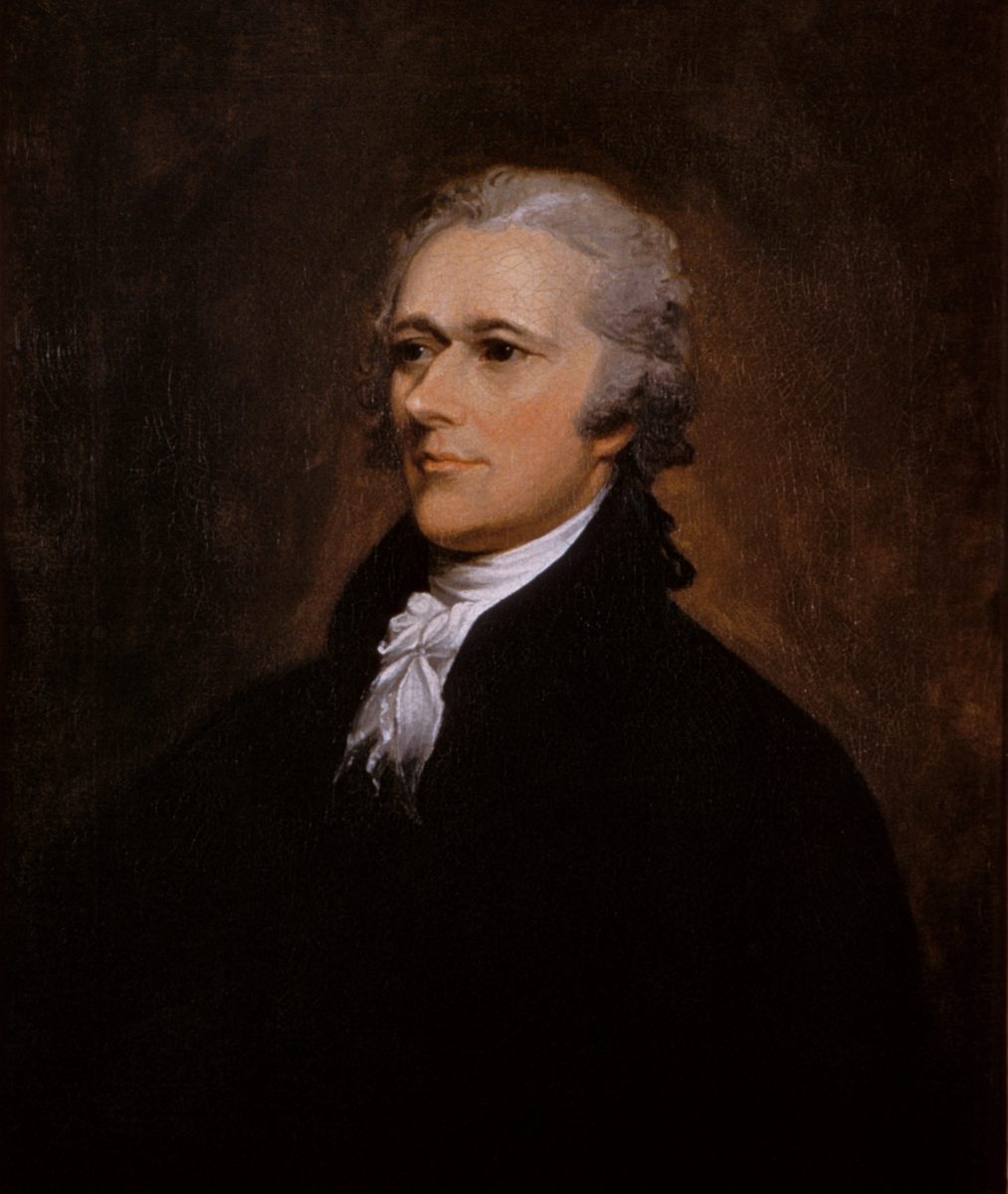
Of all the findings of this project, this is the simplest to state and the hardest to believe. Hamilton, the flamboyant young secretary at Washington’s shoulder through eight years of war, the principal architect of the financial system of the new Republic, the author of fifty-one of The Federalist Papers, the man whose oratory was so vivid that political opponents complained he would talk for five hours when one would do, Hamilton appears to have read very little Shakespeare. Or, at minimum: he never tells you so. In over two million words of writing across thirty-five years, the corpus finds essentially no Shakespeare.
The single exception
Jefferson has been President for nine months. Hamilton, now a retired private citizen and the most influential Federalist polemicist in New York, is writing newspaper attacks under the pseudonym Lucius Crassus, the Roman orator whose voice Hamilton borrows because the actual Hamilton is too obvious a Federalist to sign his own name to the piece. He has written three of these so far. He sits down to write the fourth, on Jefferson’s recommendation to abolish the internal revenue. At the climactic indictment, Hamilton reaches for Shakespeare exactly once:
Shakespeare’s actual lines, from Macbeth’s last speech before his death, are: “And be these juggling fiends no more believ’d, / That palter with us in a double sense; / That keep the word of promise to our ear, / And break it to our hope.” Hamilton has compressed and paraphrased. He has also moved the speaker: in Shakespeare, Macbeth says this about the witches; in Hamilton, the witches themselves are the comparison object, and Jefferson is implicitly the new figure being paltered with by them. The paraphrase is fluent enough that the project’s exact-phrase matcher did not detect it; the case study found it by reading.
Two things are striking about this single sighting. The first is what it isn’t. It is not the act of a man carrying Macbeth around in his head. It is the act of a man reaching, once, for a recognizable Shakespearean figure because it is the most damaging available comparison for a political enemy. The second is when it happens. Hamilton is forty-four, three years away from being shot dead by Aaron Burr, and writing his most scorched-earth journalism. If a corpus contains exactly one overt Shakespeare reference and the reference is used as a slur against a sitting President, the corpus is telling you something about what role Shakespeare plays in the writer’s life. The role here is: weapon-of-last-resort.
An earlier passage sometimes gets cited as Hamilton’s Shakespeare exception. In an 11 September 1779 letter to John Laurens, Hamilton writes of General Charles Lee that if he “had not a little spice of the Julius Caesar or Cromwell in him, he would be a very clever fellow.” A previous version of this project treated that line as the one Shakespearean trace in Hamilton’s prose. Under the revised methodology it doesn’t qualify. Caesar paired with Cromwell is two historical strongmen, not a Shakespeare character. The Founders had the Roman Caesar through Plutarch and through eighteenth-century classical training as much as through the play, and pairing him with Cromwell (who is not in Shakespeare at all) makes the reference historical. The Shakespeare-Only Characters essay walks through why the project sets the Roman names aside when the criterion is “could only have come from a Shakespeare play.” The 1801 Macbeth slur, together with one diffused word (the “multitudinous” of Federalist 75, an inheritance from Macbeth’s “multitudinous seas”), is all the Shakespeare-attributable trace the project keeps for Hamilton.
What is in the rest of the 2.21 million words
Knowing what Hamilton does not quote should make us ask what he does. The answer, across the bulk of his Federalist and post-Federalist writing, is the Enlightenment Continental theorists and the British constitutional tradition: Montesquieu (heavily), Hume (extensively, especially the political essays), Blackstone, Vattel and the law-of-nations writers, Demosthenes and the Roman historians. The Roman pseudonyms he writes under are clues: Publius, Phocion, Camillus, Pacificus, Lucius Crassus. The intellectual company he keeps in his prose is Roman senators, Scottish philosophers, and French jurists. Shakespeare is not in the room.
This is, on its face, surprising. Hamilton was educated at King’s College (now Columbia) at a moment when Shakespeare had become standard reading for any literate anglophone. He had a famously good memory and could draft full Federalist essays at a single sitting. The absence is not lack of literary capacity; it is lack of literary interest. Where Adams turned to Lady Macbeth at twenty-nine, forty-six, sixty-three, and eighty-two, Hamilton turns to Hume.
Madison’s parallel silence
The Hamilton finding is striking only because Madison shows the same pattern. Madison wrote about 3.2 million words across his life and never names Shakespeare at all: not once, in passing or otherwise. He finishes dead last on the project’s composite, ranking sixth of six on seven of the eleven measures. He is, statistically, even more un-Shakespearean than Hamilton.
Hamilton (Trumbull, 1806).
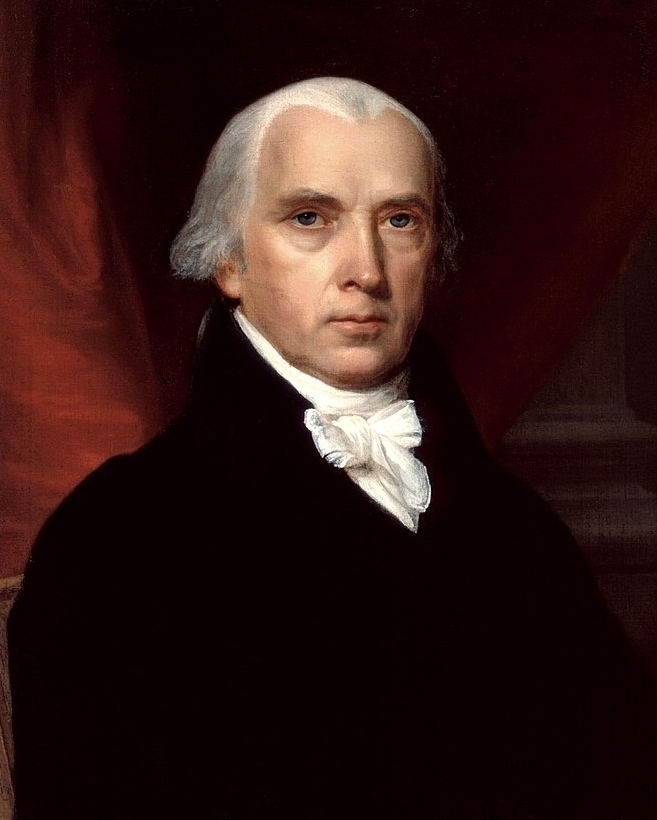
Madison (Stuart, 1804).
Madison’s silence has a different intellectual texture. Where Hamilton’s prose lives in Hume and Montesquieu, Madison’s lives in the classical republicans: Polybius on mixed constitutions, Cicero, the English Whig canon (Trenchard and Gordon’s Cato’s Letters, James Otis), and a deep current of the constitutional debates of the European confederations he had researched at Jefferson’s request. Different sources, same effect: the literary canon of the previous two centuries is not a place either of them goes for either rhetorical figure or moral measure.
Why the absence matters
The Hamilton-and-Madison silence is what makes the Adams and Franklin presences mean what they do. If all six Founders sounded equally Shakespearean, the project would be confirming a background trait of the period: educated men of the late eighteenth century all carried Shakespeare in their heads, end of finding. What the project finds is a sharp divide. Some of them did, and others didn’t.
The two-modes finding (Two Modes essay) lives on one side of that divide. On the other side, two of the six Founders (both born well into the English literary tradition, both educated, both prolific writers) produce prose in which the same tradition leaves almost no trace. Their intellectual lineages were already elsewhere before they reached for a pen. The political Republic they built is, in a real sense, the work of men who didn’t need Shakespeare to articulate it.
That is not a critical claim. It is a descriptive one. It is also one of the clearest places the corpus method earns its keep: by counting absences. A close-reading literary scholar could spend a year with Hamilton’s Federalist papers and never quite be sure whether the silence on Shakespeare was real or simply unobserved. The pipeline can be sure. More than two million words. One paraphrased Macbeth, one diffused word. The rest is Hume and the Romans.
Read the framing essay in The Hamilton Silence for the wider argument, or see Hamilton’s empty row on the Quotation Timeline.