Essay · Introduction
Chapter 2 of 9
The Influence Question
What it means to ask carefully how much of Shakespeare’s English survived into the Founders’ writing, and the setup for the rest of the site.
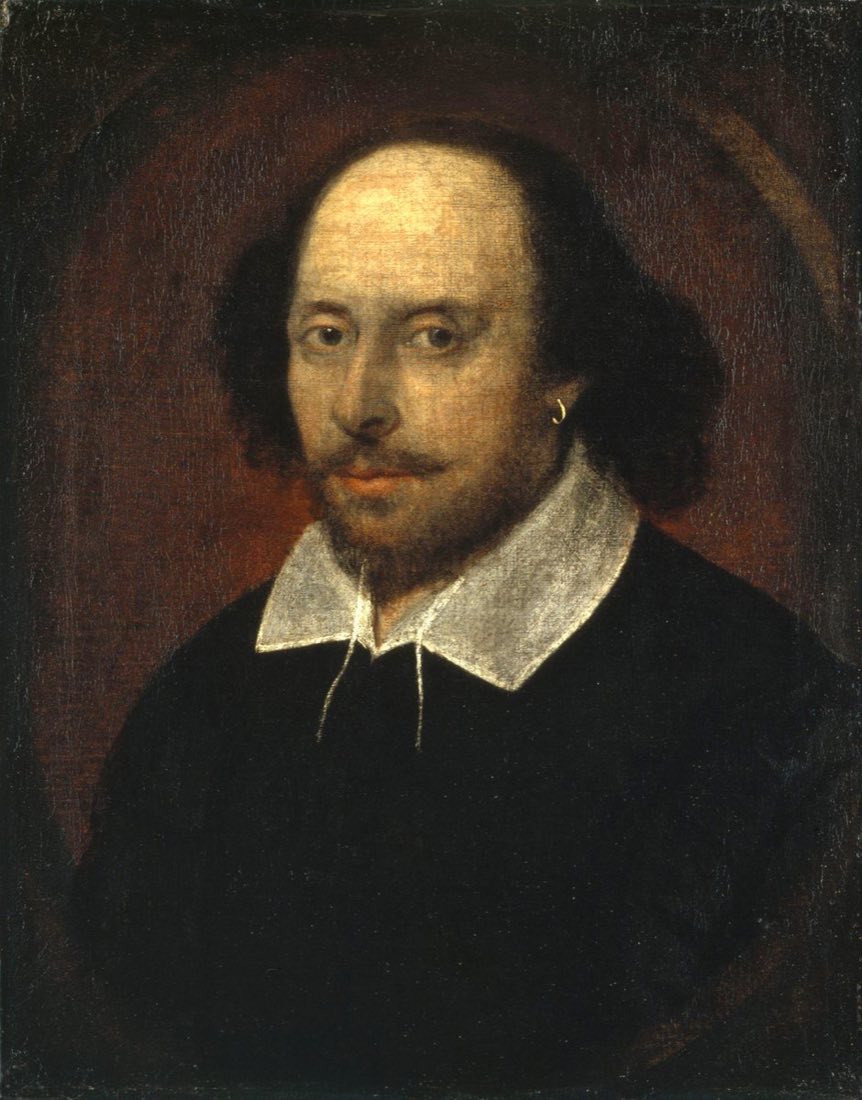
Shakespeare (Chandos portrait, c. 1610).
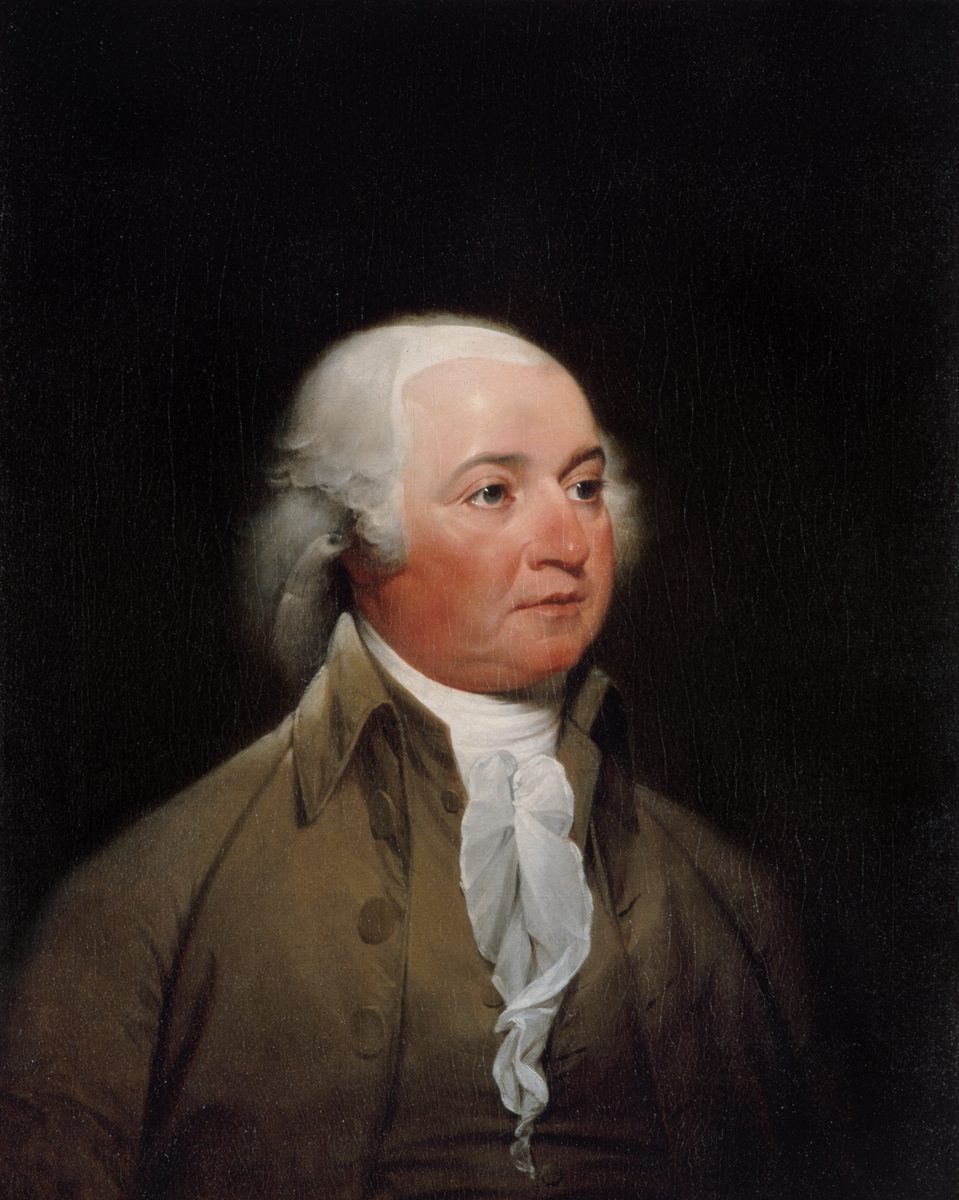
John Adams (Trumbull, c. 1792).
Almost everything we mean by “Shakespearean influence” on a later writer is, when you look at it closely, several different questions trying to wear the same hat. Did the later writer quote Shakespeare? (A literary question, addressable by reading.) Did they name him? (A biographical question, addressable by indexing.) Did they echo him, reaching for phrases, allusions, characters, themes that an educated reader of the period would have recognised? (A harder literary question, more dependent on what the reader notices.) Did the later writer sound like Shakespeare, sharing rhythm, register, sentence structure, preferred vocabulary? (A different question again, one that doesn’t lend itself to indexing at all.) Did they think like Shakespeare, in metaphors, in personifications, in dramatic ironies?
Each of these is a real question. They have different answers. And different methods catch them or miss them.
Asking the question carefully
For a project that wants to measure rather than guess, the first job is to choose which question we’re asking. The project this site documents asks one specific version of it:
Which features of Shakespeare’s English persist in the writings of six American Founders, and in whom?
The framing is deliberately one-directional. Shakespeare wrote in 1590–1614; the Founders wrote in 1750–1820. Cultural transmission is one-way through time. The question isn’t how the two corpora differ. That would be a symmetric comparison and the differences are mostly trivial (drama vs correspondence; literary vs political; an ocean and two centuries apart). The question is what survived the journey from Shakespeare into the Founders, and whose pages it ended up in.
That choice of framing shapes everything downstream. Each of the project’s analyses first identifies what’s distinctively Shakespearean about Shakespeare’s English (the words he uses heavily, the contexts he places them in, the metaphors he reaches for, the older forms thou, hath, ‘tis he writes in), then measures how much of that distinctively Shakespearean material survives in each individual Founder’s prose. The detailed setup is in the next chapter, How We Asked the Question.
Three findings in summary
I’ll preview the project’s substantive findings here, briefly, so the rest of the site has a shape to fit into. Each finding has its own essay; the essays are written to stand alone, but they’re structured to read in order.
First: there are two distinct modes of inheritance, not one.
Across the six Founders, Adams and Franklin sit at the top of every comparison the project ran. Adams leads the composite. Franklin sits within a hair behind. They got there in completely different ways. Adams quotes Shakespeare explicitly, names him more than forty times across his life, and returns to favourite Shakespearean lines over and over: deploying Brutus’s “tide in the affairs of men” in correspondence in 1776, 1781, 1809, 1812, and 1814; using the Shakespearean construction methinks I hear across thirty-two years in four completely different rhetorical situations; quoting Antony’s “Cry havock! and let slip the dogs of war” in a letter to his grandson eight months before his own death.
Franklin never quotes Shakespeare and barely mentions him. But his prose carries an older English register that overlaps Shakespeare’s seventeenth-century idiom more than any other Founder’s. He uses the archaic contraction ‘tis at two and a half times the rate of any other Founder and more than ten times the rate of Adams and Washington. He uses the old verb forms hath, doth, art, hast. He uses the second-person archaic thou, thee, thy, thine hundreds of times more often than Washington. He learned all of this at sixteen, in his half-brother’s Boston print shop in 1722, where the late-Stuart prose Bunyan, Addison, and the King James Bible all share with Shakespeare was still part of working English. The register never left him; hath survives into his 1778 diplomatic correspondence from Paris. The question of how much of this overlap is specifically Shakespearean versus older-English-in-general is hard for the project to settle cleanly. Franklin sits second on the composite because his prose touches Shakespeare more than the others’ does, not because he was reading the plays.
Adams inherits a writer. Franklin inherits a way of writing. Neither mode is more “influence” than the other, but the two modes are caught by different methods, and a project that ran only one method would see only one of them. The full argument is in the Two Modes essay.
Second: shared vocabulary is not shared meaning.
Both Shakespeare and the Founders use the word honour constantly. The Founders use it 18,632 times; Shakespeare uses it 726, which works out to roughly the same rate per million words, since the Founders’ corpus is about twenty-seven times larger. So the word survived the journey. But what the word means didn’t. In Shakespeare, honour is something a character can “pawn” like money: staked as security for someone else’s reliability. In the Founders’ correspondence, it’s a politeness marker (“I have the honour to be, Sir, your obedient servant”). Two completely different things, same English word.
That kind of pattern recurs across every politically loaded abstract noun the project examined: power, love, death, friend, mind, people, virtue. The Founders inherited Shakespeare’s vocabulary and rebuilt the world it described. The argument is in the Honour Test case study; you can browse the comparison directly in the Honour Test explorer.
Third: two of the six Founders effectively opted out.
Across Hamilton’s entire corpus (2.21 million words, 7,007 documents) the project finds zero verbatim Shakespeare quotations, zero by-name references to Shakespeare, and zero shared high-confidence stylistic features under the project’s stylometric test. Madison’s record is even quieter.
This isn’t a story about ignorance. Both men had read Shakespeare. Hamilton drew heavily on Roman political history, but through Plutarch and the classical historians, not through Shakespeare’s Roman plays in any identifiable way. His intellectual models were Hume, Montesquieu, Blackstone, the modern political philosophers. His prose belongs to a completely different tradition. Shakespeare simply isn’t in it; the corpus can record the absence, not the reason. The discussion is in the Hamilton Silence essay.
Why the three findings need each other
Taken alone, the Adams finding could be a literary scholar’s traditional argument: that a specific Founder was well-read in Shakespeare and used him. Taken alone, the Franklin finding could be a corpus linguist’s traditional argument: that early register-formation shaped a writer’s lifelong prose. Taken alone, the Hamilton finding could be a methodological complaint, that the project’s tools missed something Hamilton was doing.
Taken together, the three findings make a different and sharper argument: that Shakespearean influence on American political prose was a choice, not an inevitability. The Founders had access to similar educations. They didn’t produce similar prose. Two actively integrated Shakespearean material; two left almost no trace of it; two were somewhere in the middle. The distribution is biographically interpretable. Each Founder’s choices about which intellectual tradition to write inside of are visible in the data, and the distribution they collectively produce is the substantive finding of the project as a whole.
How to read on
If you want the substantive findings, in order, read the findings chapters: Two Modes, the Honour Test case study, Eleven Ways of Looking (which is the “why we believe the findings” chapter), and The Hamilton Silence.
If you want the methodology, the methods chapter is the next stop. It’s written for general readers and stays out of statistical detail unless the reader chooses to open the “for the methodologically curious” foldable sections.
If you want the specific stories (Adams quoting Shakespeare at twenty-three, Washington at Valley Forge, Franklin at sixteen, Adams at eighty-six) read the case studies.
If you want to see the underlying data and ask questions of it directly, the explorer has a filterable catalogue of every traceable Shakespeare reference and an interactive comparison view for fourteen common abstract nouns.
Continue to the methods chapter for the careful setup, or jump straight to Two Modes of Shakespearean Influence for the central substantive finding.